Table of Contents
ToggleBest AI Marketing Workflow Automation: How Intelligent Systems Are Redefining Modern Marketing
Introduction: Marketing Has Entered the Automation Intelligence Era
Marketing today is no longer just about creativity, campaigns, or channels. It is about systems. Brands that win are not working harder—they are working smarter, powered by artificial intelligence.
As customer journeys become fragmented across platforms and touchpoints, manual marketing execution is breaking down. Managing emails, ads, social media, leads, analytics, and personalization separately leads to inefficiency, delays, and lost revenue.
This is where AI Marketing Workflow Automation becomes transformational.
AI-driven workflows allow businesses to connect data, automate actions, predict outcomes, and optimize performance continuously—without constant human intervention. Instead of reacting to customer behavior, AI-driven systems anticipate it.
This in-depth guide explores:
-
What AI marketing workflow automation truly means
-
Why it is essential for scalable growth
-
How AI-powered workflows function end to end
-
The best use cases across the marketing funnel
-
A step-by-step framework to implement AI workflows
-
Future trends shaping AI-driven marketing
If you want to build a marketing engine that runs 24/7, learns continuously, and scales profitably, this guide is for you.
What Is AI Marketing Workflow Automation?
AI Marketing Workflow Automation is the use of artificial intelligence to design, execute, manage, and optimize marketing workflows across channels by analyzing data, predicting behavior, and triggering automated actions.
Unlike basic automation tools that rely on fixed rules, AI-driven workflows:
-
Learn from historical and real-time data
-
Adapt to customer behavior dynamically
-
Predict future actions
-
Optimize outcomes continuously
In Simple Terms:
AI marketing workflow automation turns marketing processes into self-improving systems rather than static campaigns.
Why Traditional Marketing Automation Is No Longer Enough
Traditional automation tools were built for a simpler time. They rely on:
-
If-this-then-that rules
-
Static customer segments
-
Manual optimization
In contrast, modern marketing requires:
-
Real-time personalization
-
Predictive decision-making
-
Cross-channel orchestration
-
Scalable optimization
AI marketing workflow automation bridges this gap by introducing intelligence into automation.
Key Differences: Rule-Based vs AI-Driven Workflows
| Feature | Rule-Based Automation | AI Workflow Automation |
|---|---|---|
| Logic | Predefined rules | Self-learning models |
| Segmentation | Static | Dynamic & predictive |
| Optimization | Manual | Continuous & automatic |
| Personalization | Limited | Individual-level |
| Scalability | Low | High |
AI workflows don’t just execute tasks—they decide which tasks matter most.
Why AI Marketing Workflow Automation Is Critical for Growth
1. Rising Customer Expectations
Customers expect:
-
Relevant messages
-
Personalized experiences
-
Instant responses
AI-driven workflows meet these expectations at scale.
2. Data Overload
Marketing generates massive data volumes. AI:
-
Identifies patterns humans miss
-
Converts data into actionable insights
-
Drives faster decisions
3. Cost Efficiency
AI reduces:
-
Manual labor
-
Campaign inefficiencies
-
Wasted ad spend
This directly improves ROI.
4. Speed & Agility
AI systems respond in real time—something manual teams cannot match.
Core Building Blocks of AI Marketing Workflow Automation
1. Unified Data Layer
AI requires a centralized view of customer data from:
-
Websites
-
CRM systems
-
Email platforms
-
Ads and social media
-
Support systems
Clean, connected data is the foundation of automation intelligence.
2. AI & Machine Learning Engine
This layer powers:
-
Predictive lead scoring
-
Behavioral analysis
-
Content recommendations
-
Churn prediction
The engine improves as it processes more data.
3. Workflow Automation Layer
This executes actions such as:
-
Sending emails
-
Triggering ads
-
Updating CRM records
-
Notifying sales teams
4. Content Intelligence Layer
AI helps create and optimize:
-
Emails
-
Ads
-
Blogs
-
Landing pages
Content becomes dynamic and personalized.
5. Analytics & Optimization Layer
AI monitors performance and:
-
Adjusts workflows
-
Reallocates budgets
-
Improves messaging
Optimization becomes continuous, not periodic.
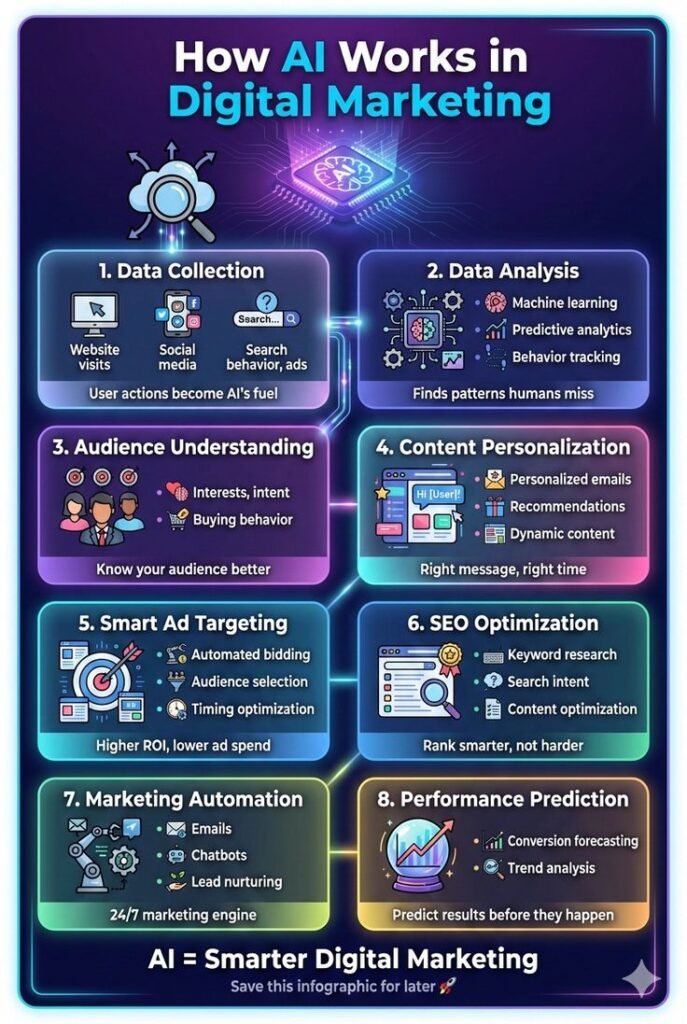
How AI Marketing Workflow Automation Works (End-to-End)
Step 1: Data Collection
AI collects behavioral, transactional, and engagement data from all marketing touchpoints.
Step 2: Customer Profiling
AI builds intelligent profiles using:
-
Engagement history
-
Purchase behavior
-
Intent signals
Step 3: Predictive Insights
AI predicts:
-
Conversion probability
-
Best communication timing
-
Most effective channel
Step 4: Automated Execution
Workflows trigger personalized actions across channels automatically.
Step 5: Learning & Optimization
AI evaluates results and continuously improves performance.
High-Impact Use Cases of AI Marketing Workflow Automation
1. AI-Powered Lead Qualification
AI identifies high-quality leads based on behavior, not just form fills, and routes them automatically.
2. Intelligent Lead Nurturing
AI adapts nurture sequences based on:
-
Content engagement
-
Funnel stage
-
Purchase readiness
3. Personalized Email Automation
AI optimizes:
-
Subject lines
-
Content blocks
-
Send timing
This increases engagement significantly.
4. Paid Media Workflow Automation
AI manages:
-
Bid strategies
-
Budget distribution
-
Creative testing
-
Audience targeting
Campaigns improve without manual adjustments.
5. Content Marketing Automation
AI supports:
-
Topic ideation
-
SEO optimization
-
Content repurposing
-
Performance prediction
6. Conversational AI & Chatbots
AI chatbots qualify leads, answer questions, and trigger workflows instantly.
7. Retention & Upsell Automation
AI predicts churn and triggers:
-
Retention offers
-
Loyalty campaigns
-
Personalized upsells
Best AI Tools for Marketing Workflow Automation
All-in-One Platforms
-
HubSpot AI
-
Salesforce Einstein
-
Zoho AI
Content & Copy Automation
-
ChatGPT
-
Jasper
-
Copy.ai
Ad & Performance Automation
-
Google Ads AI
-
Meta Advantage+
-
Smartly.io
Analytics & Insights
-
GA4
-
Looker Studio
-
Tableau AI
Step-by-Step Framework to Implement AI Marketing Workflows
Step 1: Identify Repetitive & High-Impact Tasks
Start with workflows that consume the most time.
Step 2: Define Clear KPIs
Examples:
-
Conversion rate improvement
-
Cost per lead reduction
-
Engagement growth
Step 3: Choose the Right AI Stack
Focus on integration, scalability, and data compatibility.
Step 4: Design Intelligent Workflows
Combine:
-
Predictive models
-
Behavioral triggers
-
Automated actions
Step 5: Monitor, Train & Improve
AI requires continuous data input and human oversight.
Best Practices for AI Marketing Workflow Automation
-
Start small, then scale
-
Maintain brand voice control
-
Prioritize data accuracy
-
Avoid over-automation
-
Align marketing and sales teams
Benefits of AI Marketing Workflow Automation
-
Faster execution
-
Higher personalization
-
Improved ROI
-
Reduced operational costs
-
Scalable marketing systems
-
Better customer experience
Common Challenges and How to Overcome Them
-
Data silos: Integrate platforms
-
Skill gaps: Train teams
-
Over-dependence on AI: Keep human oversight
-
Privacy risks: Follow compliance standards
Future Trends in AI Marketing Workflow Automation
-
Autonomous marketing campaigns
-
Predictive revenue optimization
-
Voice-driven workflows
-
Hyper-personalized journeys
The future belongs to self-optimizing marketing systems.
Conclusion: AI Workflow Automation Is the New Marketing Infrastructure
AI marketing workflow automation is not about replacing marketers—it is about building systems that amplify human intelligence.
Brands that adopt AI-driven workflows will:
-
Scale faster
-
Operate leaner
-
Deliver better experiences
In the coming years, the question won’t be “Should we use AI in marketing?”
It will be “How advanced is our AI marketing workflow?”