Table of Contents
ToggleThe Best Interactive Content Strategy in 2026: The Complete 3000-Word Guide to Driving Engagement, Leads & Conversions
Attention is the most valuable currency in digital marketing — and traditional content is losing its grip.
Static blog posts, generic PDFs, and one-way communication are no longer enough. Today’s audiences expect experiences, not just information.
That’s where interactive content wins.
Interactive content transforms passive readers into active participants. It increases engagement, boosts conversions, and provides valuable first-party data.
In this comprehensive guide, you’ll learn:
-
What interactive content really is
-
Why it outperforms static content
-
Types of interactive content
-
Real-world examples
-
How to build an interactive content strategy
-
Tools to use
-
SEO & lead generation benefits
-
Mistakes to avoid
-
A 90-day execution roadmap
Let’s dive in.
1. What Is Interactive Content?
Interactive content is content that requires active participation from the user rather than passive consumption.
Instead of just reading, users:
-
Click
-
Answer
-
Choose
-
Vote
-
Calculate
-
Explore
-
Customize
Examples include:
-
Quizzes
-
Polls
-
Surveys
-
Calculators
-
Interactive infographics
-
Assessments
-
Configurators
-
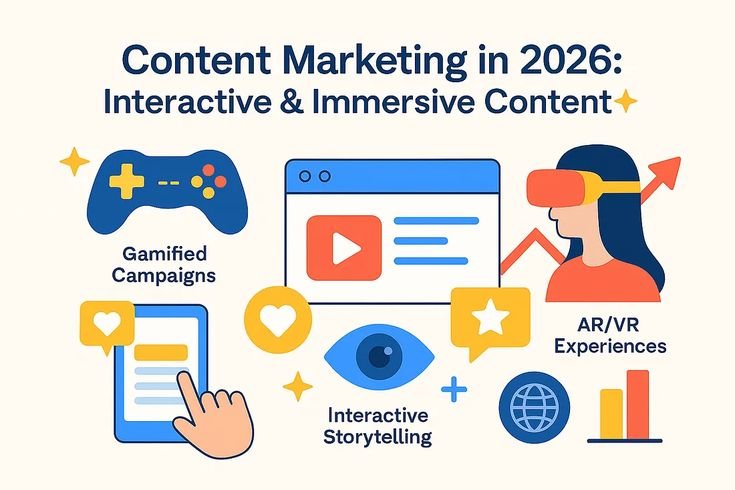
AR/VR experiences
Unlike traditional blog posts, interactive content creates a two-way conversation.
2. Why Interactive Content Works So Well
Modern audiences are overwhelmed.
Social platforms like Instagram and TikTok have trained users to expect engaging, fast, and immersive experiences.
Interactive content works because it:
-
Increases time on page
-
Boosts engagement rates
-
Improves information retention
-
Generates first-party data
-
Increases social shares
-
Improves conversion rates
When users participate, they become emotionally invested.
And invested users convert.
3. The Psychology Behind Interactive Content
Interactive content taps into powerful psychological triggers:
1. Curiosity
“Find out your marketing score.”
2. Personalization
“Get your custom growth plan.”
3. Instant Feedback
“See your results immediately.”
4. Gamification
Badges, points, progress bars.
5. Control
Users choose their own path.
This sense of control increases satisfaction and trust.
4. Types of High-Performing Interactive Content
Let’s break down the most effective formats.
1. Quizzes & Assessments
Quizzes are one of the highest-converting interactive formats.
Examples:
-
“What Type of Entrepreneur Are You?”
-
“Test Your SEO Knowledge”
-
“Find Your Perfect Skincare Routine”
Brands like BuzzFeed built massive engagement using quizzes.
Why They Work
-
Personalized results
-
Social sharing potential
-
Email capture opportunity
2. Calculators
Calculators provide immediate, tangible value.
Examples:
-
ROI calculator
-
Savings estimator
-
Mortgage calculator
-
Marketing budget planner
Financial brands like NerdWallet use calculators to drive qualified leads.
Calculators build authority and trust.
3. Interactive Infographics
Instead of static visuals, users click to explore sections.
Benefits:
-
Better storytelling
-
Improved data retention
-
Increased engagement
4. Polls & Surveys
Simple but powerful.
Polls increase engagement on platforms like LinkedIn and Twitter.
Surveys provide valuable customer insights.
5. Product Configurators
Allow users to customize products:
-
Car model selection
-
Laptop configuration
-
Software plan builder
E-commerce brands use configurators to increase purchase intent.
6. Interactive Videos
Clickable videos allow users to choose what happens next.
Streaming platforms like Netflix experimented with interactive storytelling formats.
Interactive video increases retention dramatically.
7. AR/VR Experiences
Augmented reality allows users to “try before they buy.”
Brands like IKEA allow users to visualize furniture in their homes.
Immersive experiences increase buying confidence.
5. Benefits of Interactive Content for Marketing
1. Higher Engagement
Interactive content generates 2x more engagement than static content.
2. Better Lead Qualification
Answers provided by users reveal intent and preferences.
3. Improved Conversion Rates
Personalized results increase relevance.
4. First-Party Data Collection
With increasing privacy regulations, first-party data is critical.
5. Stronger Brand Recall
Participation improves memory retention.
6. Interactive Content & SEO
Interactive content improves SEO by:
-
Increasing dwell time
-
Reducing bounce rate
-
Attracting backlinks
-
Encouraging social sharing
Search engines like Google reward user engagement signals.
When users stay longer and interact more, rankings improve.
7. How to Build an Interactive Content Strategy
Here’s a step-by-step framework.
Step 1: Define Your Goal
Is your objective:
-
Lead generation?
-
Brand awareness?
-
Product education?
-
Customer segmentation?
Your goal determines the format.
Step 2: Understand Your Audience
Identify:
-
Pain points
-
Goals
-
Challenges
-
Preferences
Interactive content must feel relevant.
Step 3: Choose the Right Format
Lead Gen → Quiz or Calculator
Education → Interactive Infographic
Engagement → Poll
Sales → Configurator
Step 4: Offer Value First
Users won’t engage without value.
Ask:
“What does the user gain?”
Step 5: Add Email Capture Smartly
Don’t gate everything.
Instead:
-
Show partial results
-
Offer full report via email
Step 6: Promote Strategically
Promote via:
-
Email campaigns
-
Social media
-
Paid ads
-
Website popups
-
Landing pages
8. Tools for Creating Interactive Content
Several tools simplify creation:
-
Typeform – Interactive surveys & quizzes
-
Outgrow – Calculators & quizzes
-
Ceros – Interactive design experiences
-
Canva – Visual elements
-
HubSpot – Lead capture integration
Choose based on complexity and budget.
9. Interactive Content for Different Industries
E-commerce
-
Product quizzes
-
Size finders
-
Virtual try-ons
SaaS
-
ROI calculators
-
Product assessment tools
-
Interactive demos
Education
-
Skill assessments
-
Learning path selectors
-
Knowledge quizzes
Finance
-
Savings calculators
-
Risk assessments
Interactive content adapts to every niche.
10. Measuring Interactive Content Success
Track:
-
Completion rate
-
Engagement rate
-
Time on page
-
Lead capture rate
-
Conversion rate
-
Social shares
Analyze drop-off points to improve performance.
11. Common Mistakes to Avoid
❌ Making it too complex
❌ Asking too many questions
❌ Not offering value
❌ Poor mobile experience
❌ No follow-up strategy
❌ Over-gating results
Keep it simple and purposeful.
12. The 90-Day Interactive Content Plan
Month 1: Planning
-
Identify audience segments
-
Choose format
-
Design structure
-
Build prototype
Month 2: Launch
-
Publish interactive asset
-
Promote via email & social
-
Run paid campaigns
-
Track metrics
Month 3: Optimize
-
Improve drop-off points
-
A/B test headlines
-
Add personalization
-
Repurpose insights
Scale what works.
13. Future Trends in Interactive Content
Interactive content is evolving toward:
-
AI-powered personalization
-
Real-time adaptive quizzes
-
Voice-interactive experiences
-
Gamified learning modules
-
Immersive AR commerce
As attention becomes harder to earn, interactivity becomes essential.
14. Interactive Content + AI
AI enhances interactive content by:
-
Personalizing results dynamically
-
Predicting user preferences
-
Automating follow-ups
-
Segmenting users instantly
AI makes interactive content smarter and more scalable.
Final Thoughts: Participation Drives Performance
Interactive content isn’t just a trend.
It’s a shift from broadcasting to engaging.
The brands that win in 2026 will:
-
Invite users to participate
-
Personalize experiences
-
Deliver immediate value
-
Collect meaningful insights
If static content informs, interactive content transforms.
And transformation drives conversion.