Table of Contents
ToggleBest Programmatic Advertising: The Ultimate Guid in (2026 Edition)
Programmatic advertising has revolutionized how brands buy, place, and optimize digital ads. Instead of manual negotiations and insertion orders, programmatic uses automation, artificial intelligence (AI), and real-time bidding (RTB) to deliver highly targeted ads to the right audience at the right time.
In this comprehensive guide, you’ll learn everything about programmatic advertising—how it works, its benefits, strategies, platforms, trends, and how to build high-performing campaigns in 2026 and beyond.
What is Programmatic Advertising?
Programmatic advertising is the automated process of buying and selling digital advertising space using software and algorithms. It eliminates human intervention in media buying and uses data-driven decision-making to optimize ad placements.
At its core, programmatic relies on:
- Real-time bidding (RTB)
- Machine learning algorithms
- Audience data and targeting
- Automated campaign optimization
Every time a user visits a webpage or app, an auction happens in milliseconds, and the highest bidder wins the ad placement.
How Programmatic Advertising Works
The programmatic ecosystem includes several key components:
1. Demand-Side Platform (DSP)
Advertisers use DSPs to buy ad inventory across multiple publishers.
2. Supply-Side Platform (SSP)
Publishers use SSPs to sell their ad inventory.
3. Ad Exchange
A digital marketplace where buying and selling of ads occur in real time.
4. Data Management Platform (DMP)
Collects and analyzes audience data for targeting.
5. Ad Server
Delivers ads to users and tracks performance.
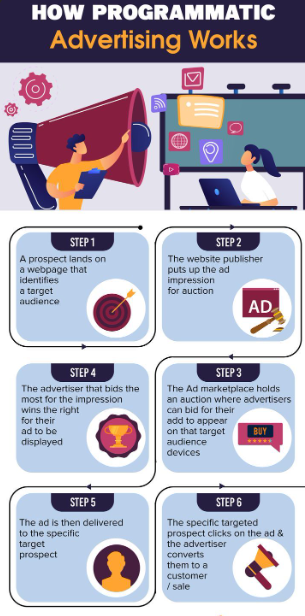
Step-by-Step Process:
- User visits a website
- Ad impression becomes available
- DSP evaluates user data
- Advertisers bid in real-time
- Highest bidder wins
- Ad is displayed instantly
This entire process takes less than 100 milliseconds.
Types of Programmatic Advertising
1. Real-Time Bidding (RTB)
Open auction where multiple advertisers compete for impressions.
2. Private Marketplace (PMP)
Invite-only auctions with premium publishers.
3. Programmatic Direct
Fixed pricing deals between advertisers and publishers.
4. Preferred Deals
Advertisers get first access to inventory before auctions.
Benefits of Programmatic Advertising
1. Advanced Targeting
Programmatic allows hyper-targeting based on:
- Demographics
- Interests
- Behavior
- Location
- Device
2. Real-Time Optimization
Campaigns can be adjusted instantly based on performance.
3. Efficiency and Automation
Automation reduces manual work and improves efficiency.
4. Better ROI
AI-driven optimization improves conversion rates and reduces waste
5. Cross-Channel Reach
Ads can appear across:
- Websites
- Mobile apps
- Video platforms
- Connected TV
Key Programmatic Advertising Channels
1. Display Advertising
Banner ads on websites and apps.
2. Video Advertising
In-stream and out-stream video ads.
3. Native Advertising
Blends with content for better engagement.
4. Connected TV (CTV) & OTT
Streaming platforms are becoming dominant channels
5. Digital Out-of-Home (DOOH)
Billboards and public displays powered by programmatic
6. Audio Advertising
Podcasts and music streaming ads.
Programmatic Advertising Strategies
1. Use First-Party Data
With privacy changes and cookie deprecation, first-party data is critical. Brands are building their own data ecosystems through CRM, apps, and customer interactions
2. Implement AI and Machine Learning
AI enables:
- Predictive targeting
- Automated bidding
- Audience segmentation
AI can process thousands of signals per second to optimize campaigns
3. Dynamic Creative Optimization (DCO)
DCO automatically adjusts ad creatives based on user data, increasing engagement and conversions
4. Omnichannel Marketing
Run integrated campaigns across:
- Mobile
- Desktop
- CTV
- Audio
- Social
5. Contextual Targeting
Instead of relying on cookies, contextual targeting focuses on:
- Page content
- Keywords
- User intent
6. Focus on Brand Safety
Use tools to ensure ads appear in safe and relevant environments. This is increasingly important due to rising ad fraud risks
Best Programmatic Advertising Platforms
Here are some of the top platforms used globally:
Demand-Side Platforms (DSPs)
- Google Display & Video 360
- The Trade Desk
- Amazon DSP
- MediaMath
Supply-Side Platforms (SSPs)
- Google Ad Manager
- PubMatic
- OpenX
Data Platforms
- Salesforce DMP
- Adobe Audience Manager
These tools help manage campaigns, optimize performance, and scale advertising efforts.
Programmatic Advertising Trends in 2026
1. AI-Driven Personalization
AI is enabling hyper-personalized ads based on real-time behavior and predictive analytics
2. Cookieless Advertising
With the decline of third-party cookies, first-party data and contextual targeting are becoming essential
3. Growth of CTV and Video
CTV is becoming one of the fastest-growing programmatic channels
4. Programmatic Commerce
Shoppable ads allow users to purchase directly from ads, reducing friction
5. Generative AI in Ad Creatives
AI tools can create and optimize ad creatives dynamically at scale
6. Privacy-First Advertising
Regulations like GDPR and evolving privacy laws are reshaping targeting strategies.
7. Sustainability in Advertising
Eco-friendly ad practices and reduced digital waste are gaining importance
Challenges in Programmatic Advertising
1. Ad Fraud
Programmatic ecosystems can be exploited by malicious actors, leading to fake impressions and wasted budgets.
Recent reports indicate rising risks in programmatic environments, including malware and phishing campaigns
2. Lack of Transparency
Complex supply chains make it difficult to track where ad spend goes.
3. Data Privacy Concerns
Stricter regulations limit data usage and targeting capabilities.
4. Brand Safety Issues
Ads may appear on inappropriate or low-quality websites.
5. Technical Complexity
Programmatic platforms require expertise and experience.
Best Practices for Programmatic Advertising
1. Define Clear Goals
Set measurable KPIs:
- CTR
- CPA
- ROAS
- Conversions
2. Use High-Quality Data
Focus on:
- First-party data
- Verified third-party data
- Clean data sets
3. Optimize Creatives
Use:
- A/B testing
- DCO
- Personalized messaging
4. Monitor Campaign Performance
Track metrics in real time and adjust accordingly.
5. Partner with Trusted Platforms
Choose reliable DSPs and SSPs to reduce fraud risk.
6. Leverage Automation
Use AI tools to automate:
- Bidding
- Targeting
- Optimization
Programmatic Advertising vs Traditional Advertising
| Feature | Programmatic | Traditional |
|---|---|---|
| Buying Process | Automated | Manual |
| Targeting | Data-driven | Broad |
| Optimization | Real-time | Limited |
| Cost Efficiency | High | Lower |
| Speed | Instant | Slow |
Future of Programmatic Advertising
The future of programmatic advertising is driven by:
- Artificial Intelligence
- Privacy-first ecosystems
- Omnichannel integration
- Real-time personalization
Programmatic is expected to dominate digital advertising due to its scalability, efficiency, and precision targeting.
Brands that embrace automation, data-driven strategies, and emerging technologies will gain a competitive advantage in the evolving digital landscape.
Conclusion
Programmatic advertising is no longer optional—it is essential for modern digital marketing success. By leveraging AI, data, and automation, businesses can deliver highly relevant ads, improve ROI, and scale campaigns efficiently.
However, success requires:
- Strong data strategy
- Continuous optimization
- Focus on privacy and transparency
- Adoption of emerging technologies