Table of Contents
ToggleBest Account-Based Marketing Strategy: The Ultimate 3000-Word Guide to High-Impact B2B Growth
In B2B marketing, volume no longer wins—precision does.
As sales cycles grow longer, buying committees expand, and customer acquisition costs rise, traditional lead-based marketing struggles to deliver predictable ROI. This is why high-performing B2B companies are shifting toward Account-Based Marketing (ABM)—a strategy built around quality, relevance, and revenue impact.
This comprehensive guide explains what ABM really is, why it works, how to build an effective ABM strategy, and how top companies execute ABM at scale.
What Is Account-Based Marketing (ABM)?
Account-Based Marketing is a strategic B2B approach where marketing and sales teams work together to target specific high-value accounts with personalized campaigns, messaging, and experiences.
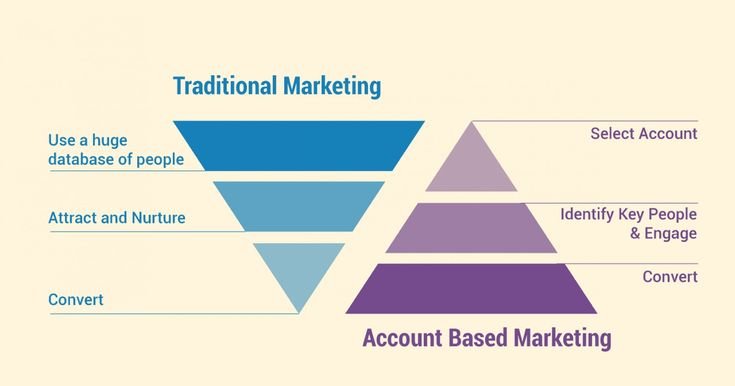
Instead of generating thousands of leads and hoping some convert, ABM flips the funnel:
-
Identify the right accounts first
-
Personalize outreach for each account
-
Engage multiple stakeholders
-
Focus on pipeline and revenue, not MQLs
ABM treats accounts as markets.
Why Account-Based Marketing Matters Today
1. B2B Buying Has Changed
Modern B2B purchases involve:
-
6–10 stakeholders
-
Long evaluation cycles
-
Multiple channels and touchpoints
Generic campaigns fail to resonate with complex buying groups.
2. Higher ROI Than Traditional Demand Gen
Studies consistently show ABM delivers:
-
Higher deal sizes
-
Better close rates
-
Shorter sales cycles
-
Stronger customer retention
That’s why platforms like Salesforce and HubSpot heavily promote ABM as a core B2B growth model.
3. Sales and Marketing Alignment
ABM forces alignment:
-
Shared account lists
-
Shared goals
-
Shared metrics
When sales and marketing chase the same accounts, execution improves dramatically.
ABM vs Traditional B2B Marketing
| Aspect | Traditional Marketing | Account-Based Marketing |
|---|---|---|
| Focus | Leads | Accounts |
| Targeting | Broad | Highly specific |
| Personalization | Light | Deep |
| Success Metrics | MQLs | Pipeline & revenue |
| Sales Alignment | Optional | Mandatory |
ABM prioritizes impact over volume.
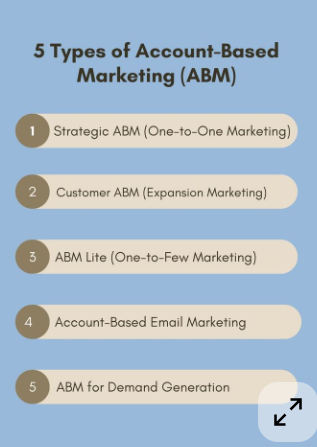
Types of Account-Based Marketing
1. One-to-One ABM (Strategic ABM)
Highly personalized campaigns for a small number of high-value accounts.
Best for: Enterprise deals, long sales cycles
Example: Custom microsites, executive events, personalized demos
2. One-to-Few ABM (ABM Lite)
Accounts grouped by industry, size, or use case.
Best for: Mid-market B2B
Example: Industry-specific campaigns
3. One-to-Many ABM (Programmatic ABM)
Technology-driven personalization at scale.
Best for: Scaling ABM efficiently
Example: Personalized ads and emails using intent data
Most mature ABM programs combine all three.
Core Pillars of a Successful ABM Strategy
1. Ideal Customer Profile (ICP) Definition
Strong ABM starts with precision targeting.
Define your ICP using:
-
Industry
-
Company size
-
Revenue
-
Tech stack
-
Buying triggers
ABM fails when account selection is weak.
2. Account Selection & Prioritization
Rank accounts by:
-
Revenue potential
-
Deal likelihood
-
Strategic value
Use CRM and intent data to prioritize intelligently.
3. Buying Committee Mapping
Every account has multiple stakeholders:
-
Decision-makers
-
Influencers
-
Gatekeepers
-
End users
ABM campaigns must address each role differently.
4. Personalized Messaging
Generic messaging kills ABM performance.
Personalize based on:
-
Industry pain points
-
Company initiatives
-
Role-specific goals
Relevance drives engagement.
ABM Tech Stack Essentials
CRM
Your system of record for accounts, opportunities, and engagement.
Example: Salesforce
Marketing Automation
Enables account-level targeting and personalization.
Example: HubSpot
Intent Data Platforms
Reveal which accounts are actively researching solutions.
Example: Bombora
Advertising Platforms
Deliver targeted ads to specific accounts.
Example: LinkedIn Ads
Technology supports ABM—but strategy drives success.
How to Build an ABM Strategy Step by Step
Step 1: Align Sales and Marketing
Define:
-
Shared account lists
-
Shared goals
-
Shared KPIs
Without alignment, ABM becomes “marketing pretending to do sales.”
Step 2: Identify Target Accounts
Use:
-
Historical win data
-
Sales input
-
Intent signals
-
Predictive scoring
Quality > quantity.
Step 3: Map Accounts to Buying Roles
Create personas for:
-
Executives
-
Technical buyers
-
Economic buyers
Each persona needs tailored messaging.
Step 4: Design Personalized Campaigns
Channels may include:
-
Email
-
LinkedIn ads
-
Website personalization
-
Sales outreach
-
Events
Consistency across touchpoints matters.
Step 5: Activate Sales Enablement
Marketing should arm sales with:
-
Account insights
-
Personalized assets
-
Conversation starters
ABM works when sales feels supported, not replaced.
ABM Content Strategy That Converts
Content Types That Perform Well
-
Industry case studies
-
ROI calculators
-
Personalized landing pages
-
Executive briefings
-
Custom demos
ABM content is deep and specific, not viral.
Personalization Levels
-
Company name
-
Industry use cases
-
Role-specific value propositions
The closer content feels to “this was made for us,” the better it performs.
ABM Advertising Best Practices
LinkedIn ABM Ads
LinkedIn allows targeting by:
-
Company name
-
Job title
-
Seniority
Perfect for account-level campaigns.
Display & Retargeting
Use ads to:
-
Reinforce sales outreach
-
Stay top-of-mind
-
Support long sales cycles
ABM ads should feel helpful, not aggressive.
Measuring ABM Success (The Right Way)
Account-Level Metrics
-
Account engagement score
-
Stakeholder coverage
-
Website visits by account
Pipeline Metrics
-
Pipeline velocity
-
Deal size
-
Win rate
-
Time to close
Revenue Metrics
-
Revenue per account
-
Customer lifetime value
-
Expansion revenue
If ABM isn’t tied to revenue, it’s just branding.
Common ABM Mistakes to Avoid
❌ Treating ABM as just ads
❌ Poor account selection
❌ Weak personalization
❌ No sales alignment
❌ Measuring MQLs instead of pipeline
Most ABM failures are strategic, not technical.
ABM for Different B2B Models
ABM for SaaS
Focus on:
-
Use-case driven messaging
-
Product-led insights
-
Expansion opportunities
ABM for Enterprise Sales
Prioritize:
-
Executive alignment
-
Long-term relationship building
-
Multi-channel engagement
ABM for Agencies & Services
Emphasize:
-
Proof of expertise
-
Industry specialization
-
Trust-building content
Future Trends in Account-Based Marketing
1. AI-Powered Account Scoring
Machine learning will improve:
-
Account prioritization
-
Buying intent detection
2. Deeper Personalization
Beyond names—personalized experiences across channels.
3. Revenue-Centric Reporting
ABM metrics will align more closely with finance and revenue ops.
4. ABM + Product-Led Growth
Hybrid strategies will emerge for SaaS companies.
Final Thoughts: ABM Is How Modern B2B Wins
Account-Based Marketing is not a campaign—it’s a go-to-market strategy.
Brands that succeed with ABM:
-
Focus on fewer, better accounts
-
Align sales and marketing deeply
-
Measure revenue, not vanity metrics
In a noisy B2B world, relevance is the real competitive advantage.