Table of Contents
ToggleBest AI Marketing Analytics Platforms in 2026: The Ultimate Guide for Data-Driven Growth
Introduction
In the modern digital ecosystem, data is the backbone of successful marketing strategies. However, with massive volumes of data generated every second, traditional analytics tools are no longer sufficient. This is where AI marketing analytics platforms come into play.
AI-powered analytics platforms use machine learning, predictive modeling, and automation to transform raw data into actionable insights. They help marketers understand customer behavior, optimize campaigns, and drive better ROI with minimal manual effort.
In this comprehensive guide, we’ll explore the best AI marketing analytics platforms, their features, benefits, use cases, and how to choose the right one for your business.
What is an AI Marketing Analytics Platform?
An AI marketing analytics platform is a software solution that uses artificial intelligence to:
- Analyze marketing data across channels
- Predict customer behavior
- Automate reporting and insights
- Optimize marketing campaigns in real-time
Unlike traditional analytics tools, AI platforms continuously learn and improve, making them more accurate and efficient over time.
Why AI Marketing Analytics is Important
1. Explosion of Data
Modern businesses collect data from:
- Websites
- Social media
- Ads
- CRM systems
AI helps process this data efficiently and uncover hidden patterns.
2. Real-Time Decision Making
AI platforms provide instant insights, enabling marketers to make quick decisions and adapt strategies on the fly.
3. Predictive Capabilities
AI can forecast:
- Customer lifetime value
- Purchase intent
- Campaign performance
4. Automation
AI reduces manual work by automating:
- Data analysis
- Reporting
- Campaign optimization
Key Features of AI Marketing Analytics Platforms
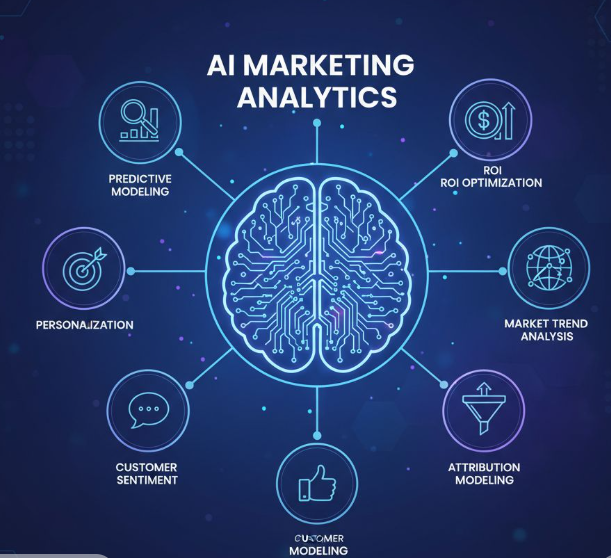
1. Predictive Analytics
Forecast future trends and customer behavior using historical data.
2. Data Integration
Combine data from multiple sources like:
- Google Ads
- Facebook Ads
- CRM systems
3. Customer Segmentation
Group customers based on:
- Behavior
- Preferences
- Demographics
4. Real-Time Dashboards
Visual dashboards provide instant insights into performance metrics.
5. Attribution Modeling
Understand which channels contribute most to conversions.
6. Automation & AI Recommendations
AI suggests actions to improve campaign performance.
Best AI Marketing Analytics Platforms in 2026
1. HubSpot Marketing Hub
HubSpot is one of the most popular AI-powered marketing platforms.
Key Features:
- Predictive lead scoring
- Automated workflows
- Integrated CRM
- Campaign analytics
It connects marketing, sales, and analytics into one ecosystem, helping businesses turn insights into revenue.
2. Salesforce Einstein
Salesforce Einstein brings AI directly into CRM systems.
Key Features:
- Predictive analytics
- Customer insights
- Automated recommendations
- Lead scoring
It helps businesses personalize customer journeys and improve conversion rates.
3. Google Analytics 4
GA4 uses machine learning to deliver advanced insights.
Key Features:
- Predictive metrics
- Cross-platform tracking
- User behavior analysis
- Event-based data tracking
Widely used for understanding website and app performance.
4. Adobe Sensei
Adobe Sensei powers AI features across Adobe’s marketing tools.
Key Features:
- Content optimization
- Customer journey analytics
- Personalization
- Predictive insights
5. IBM Watson Marketing
IBM Watson offers enterprise-level AI analytics.
Key Features:
- Natural language processing
- Customer insights
- Campaign optimization
- Automation
6. Semrush
Semrush has evolved into a powerful AI-driven marketing analytics tool.
Key Features:
- Keyword analysis
- Competitive research
- AI visibility tracking
- Content optimization
It now includes AI features for tracking performance across search engines and AI-generated results.
7. Pulsar
Pulsar specializes in audience intelligence and social analytics.
Key Features:
- Narrative analysis
- Trend detection
- Sentiment analysis
- Predictive insights
Its AI tools analyze conversations and predict trends across media channels.
8. Coupler.io
Coupler.io is a no-code AI analytics and data integration platform.
Key Features:
- Automated data syncing
- Dashboard creation
- Marketing data analysis
- Integration with BI tools
It simplifies data collection and reporting for marketers.
9. Microsoft Dynamics 365
A powerful enterprise CRM with AI analytics capabilities.
Key Features:
- Customer insights
- Sales and marketing analytics
- Automation
- Integration with Microsoft tools
10. Klaviyo
Klaviyo focuses on eCommerce marketing analytics.
Key Features:
- Customer segmentation
- Predictive analytics
- Email performance tracking
- Personalization
Benefits of Using AI Marketing Analytics Platforms
1. Better Decision Making
AI provides data-driven insights that improve strategic decisions.
2. Improved Customer Experience
Personalized interactions increase engagement and satisfaction.
3. Higher ROI
Optimized campaigns lead to better conversion rates and reduced costs.
4. Time Efficiency
Automation reduces manual effort and speeds up processes.
5. Scalability
AI platforms can handle large datasets and grow with your business.
Real-World Use Cases
1. E-commerce
- Product recommendations
- Customer segmentation
- Demand forecasting
2. B2B Marketing
- Lead scoring
- Account-based marketing
- Predictive analytics
3. Social Media Marketing
- Sentiment analysis
- Trend prediction
- Content optimization
4. Advertising
AI helps optimize:
- Ad targeting
- Budget allocation
- Creative performance
AI-driven advertising is becoming increasingly automated, with platforms aiming to fully automate ad creation and targeting by 2026.
How to Choose the Best AI Marketing Analytics Platform
1. Define Your Goals
Identify what you want to achieve:
- Better insights
- Higher conversions
- Improved customer experience
2. Evaluate Features
Look for:
- Predictive analytics
- Automation
- Data integration
- Real-time reporting
3. Consider Budget
Some platforms are expensive but offer enterprise-level features.
4. Ease of Use
Choose a platform that is user-friendly and requires minimal training.
5. Integration Capabilities
Ensure the platform integrates with your existing tools.
Challenges of AI Marketing Analytics
1. Data Privacy Concerns
Businesses must comply with data protection regulations.
2. High Costs
Advanced AI platforms can be expensive.
3. Skill Requirements
Requires expertise in data analysis and AI tools.
4. Data Quality Issues
Accurate insights depend on high-quality data.
Future Trends in AI Marketing Analytics
1. Hyper-Personalization
AI will deliver highly personalized experiences in real time.
2. AI-Driven Attribution
More accurate tracking of customer journeys across channels.
3. Predictive Customer Insights
AI will predict behavior with greater accuracy.
4. Autonomous Marketing
AI will fully automate campaigns and decision-making.
5. AI + Human Collaboration
AI will act as a strategic partner rather than just a tool.
Best Practices
- Focus on clean and structured data
- Combine AI insights with human creativity
- Continuously monitor performance
- Test and optimize campaigns
- Maintain transparency with customers
Conclusion
AI marketing analytics platforms are transforming how businesses understand and engage with customers. From predictive analytics to real-time optimization, these tools provide a competitive edge in today’s data-driven world.
Whether you are a startup or an enterprise, investing in the right AI analytics platform can significantly improve your marketing performance, customer experience, and ROI.