Table of Contents
ToggleBest AI Tools for Digital Marketing: The Ultimate 2025 Guide for Smarter Growth
Artificial Intelligence (AI) has transformed digital marketing from intuition-driven campaigns into data-powered, highly personalized growth engines. From content creation and SEO to paid advertising, analytics, customer experience, and automation, AI tools now play a central role in how modern marketers plan, execute, and optimize campaigns.
In 2025, businesses that effectively leverage AI in digital marketing gain a significant competitive advantage—lower costs, better targeting, faster execution, and higher ROI. This comprehensive guide explores the best AI tools for digital marketing, how they work, key use cases, benefits, challenges, and future trends.
What Are AI Tools for Digital Marketing?
AI tools for digital marketing use machine learning, natural language processing (NLP), predictive analytics, and automation to analyze data, generate insights, and perform marketing tasks with minimal human intervention.
These tools help marketers:
-
Understand customer behavior
-
Predict trends and outcomes
-
Create and optimize content
-
Automate repetitive tasks
-
Improve personalization at scale
Why AI Is Essential for Digital Marketing in 2025
The digital marketing landscape is more complex than ever. Multiple platforms, massive data volumes, shorter attention spans, and stricter privacy laws make traditional methods inefficient.
Key Reasons AI Matters:
-
Explosion of data from multiple channels
-
Rising cost of paid advertising
-
Demand for real-time personalization
-
Need for faster decision-making
-
Focus on ROI and performance marketing
AI enables marketers to do more with less, while delivering better customer experiences.
Core Areas Where AI Is Used in Digital Marketing
AI tools are now embedded across the entire marketing funnel:
-
Content creation and optimization
-
Search Engine Optimization (SEO)
-
Paid advertising and bidding
-
Social media management
-
Email marketing and automation
-
Lead generation and scoring
-
Customer support and chatbots
-
Analytics and performance tracking
Best AI Tools for Digital Marketing (Category-Wise)
1. Best AI Tools for Content Creation
ChatGPT
ChatGPT is one of the most widely used AI tools for digital marketing content. It helps marketers create blogs, ad copy, landing pages, email sequences, social media posts, and scripts in minutes.
Key Features:
-
Blog and article writing
-
Ad copy and CTA generation
-
Content ideation and outlines
-
Multilingual content creation
Best For: Content marketers, agencies, startups, bloggers
Jasper AI
Jasper AI specializes in marketing-focused copywriting. It is trained on high-performing marketing frameworks and works well for brand messaging.
Key Features:
-
Brand voice customization
-
SEO-friendly content
-
Sales copy templates
-
Social media captions
Best For: Copywriters and branding teams
Copy.ai
Copy.ai is ideal for short-form content and marketing creatives.
Key Features:
-
Product descriptions
-
Email subject lines
-
Social media copy
-
Landing page content
Best For: E-commerce and growth marketers
2. Best AI Tools for SEO and Search Marketing
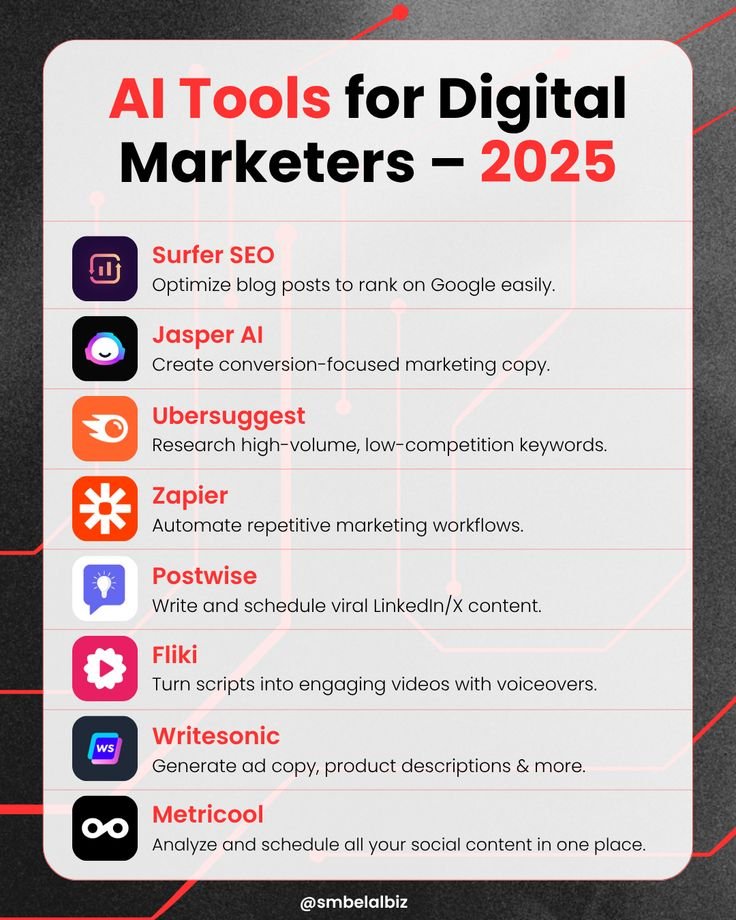
Surfer SEO
Surfer SEO uses AI-driven data analysis to optimize content for search engines.
Key Features:
-
Content scoring
-
Keyword clustering
-
SERP analysis
-
On-page optimization
Best For: SEO professionals and content teams
SEMrush (AI-Powered Features)
SEMrush integrates AI to improve keyword research, competitor analysis, and content optimization.
Key Features:
-
Keyword intent analysis
-
Topic research
-
SEO writing assistant
-
Competitive insights
Best For: Advanced SEO and PPC teams
Clearscope
Clearscope focuses on content relevance and topical authority.
Key Features:
-
Keyword recommendations
-
Content grading
-
Search intent optimization
Best For: High-quality editorial SEO
3. Best AI Tools for Paid Advertising (PPC & Performance Marketing)
Google Ads AI
Google Ads uses AI to automate bidding, targeting, and creative optimization.
Key Features:
-
Smart bidding
-
Performance Max campaigns
-
Automated audience targeting
-
Predictive conversions
Best For: Search and display advertising
Meta Ads AI (Facebook & Instagram)
Meta’s AI optimizes ad delivery, audience targeting, and creatives in real time.
Key Features:
-
Advantage+ campaigns
-
Automated placements
-
AI audience expansion
Best For: Social media performance marketing
Adzooma
Adzooma is an AI-powered PPC management platform.
Key Features:
-
Budget optimization
-
Automated recommendations
-
Performance alerts
Best For: Agencies managing multiple ad accounts
4. Best AI Tools for Social Media Marketing
Hootsuite (AI Features)
Hootsuite uses AI for content scheduling, performance prediction, and social listening.
Key Features:
-
Best-time-to-post suggestions
-
AI-generated captions
-
Sentiment analysis
Best For: Social media managers
Sprout Social
Sprout Social leverages AI for engagement insights and audience behavior analysis.
Key Features:
-
Smart inbox
-
AI-driven analytics
-
Trend detection
Best For: Brands with active social communities
Predis.ai
Predis.ai is designed specifically for AI-driven social media content creation.
Key Features:
-
Auto-generated creatives
-
Caption and hashtag suggestions
-
Competitor analysis
Best For: Small businesses and startups
5. Best AI Tools for Email Marketing & Automation
HubSpot AI
HubSpot integrates AI across CRM, email marketing, and automation.
Key Features:
-
Predictive lead scoring
-
Personalized email content
-
Workflow automation
Best For: B2B marketing and inbound strategies
Mailchimp AI
Mailchimp uses AI to optimize email timing, subject lines, and audience segmentation.
Key Features:
-
Send-time optimization
-
Smart recommendations
-
Behavioral targeting
Best For: Small to mid-sized businesses
ActiveCampaign
ActiveCampaign uses AI for advanced marketing automation.
Key Features:
-
Predictive sending
-
Customer journey mapping
-
AI-driven segmentation
Best For: Lifecycle marketing
6. Best AI Tools for Lead Generation & Sales
Drift
Drift is an AI-powered conversational marketing platform.
Key Features:
-
Chatbots for lead capture
-
Real-time conversations
-
Account-based marketing
Best For: B2B sales and SaaS companies
Zoho CRM AI (Zia)
Zoho’s AI assistant helps with lead scoring and sales predictions.
Key Features:
-
Sales forecasting
-
Lead recommendations
-
Anomaly detection
Best For: Growing sales teams
7. Best AI Tools for Analytics & Data Insights
Google Analytics 4 (GA4)
GA4 uses AI to predict user behavior and conversions.
Key Features:
-
Predictive metrics
-
Automated insights
-
Cross-device tracking
Best For: Data-driven marketing teams
Tableau with AI
Tableau integrates AI for advanced data visualization and insights.
Key Features:
-
Predictive analytics
-
Visual data storytelling
Best For: Enterprise analytics
Benefits of Using AI Tools for Digital Marketing
-
Increased productivity and efficiency
-
Better targeting and personalization
-
Improved ROI and lower costs
-
Faster decision-making
-
Data-driven campaign optimization
Challenges of AI in Digital Marketing
-
Learning curve for teams
-
Data privacy and compliance
-
Over-automation risks
-
Dependence on data quality
Balancing AI with human creativity is key to success.
Best Practices for Using AI Tools Effectively
-
Start with clear goals and KPIs
-
Use AI as an assistant, not a replacement
-
Continuously test and optimize
-
Ensure ethical and transparent data use
-
Integrate AI across channels
AI Tools for Digital Marketing for Small Businesses
AI levels the playing field for small businesses by offering:
-
Affordable automation
-
Faster content creation
-
Better targeting with smaller budgets
Even a small team can now compete with enterprise brands.
Future Trends of AI in Digital Marketing
1. Hyper-Personalization at Scale
2. AI-Generated Video & Voice Content
3. Predictive Customer Journeys
4. Cookieless AI Targeting
5. Deeper Integration with CRM & Martech
Conclusion
AI tools for digital marketing are no longer optional—they are essential. In 2025, marketers who embrace AI-driven strategies will outperform competitors in speed, relevance, and ROI. From content creation and SEO to advertising, automation, and analytics, AI empowers businesses to create smarter, more impactful marketing campaigns.