Table of Contents
ToggleThe Best Anchor Text Optimization Guide (2026 Edition)
Anchor text optimization remains one of the most powerful — and misunderstood — aspects of modern SEO. While search engine algorithms have evolved dramatically, anchor text still plays a crucial role in helping search engines understand page relevance, topical authority, and contextual relationships.
In this comprehensive 3000-word guide, you’ll learn:
-
What anchor text really is
-
Why it matters for rankings
-
Types of anchor text (with examples)
-
Exact-match vs. natural anchors
-
Internal vs. external anchor strategies
-
Anchor text distribution best practices
-
Common mistakes to avoid
-
Advanced optimization tactics for 2026
Let’s dive in.
1. What Is Anchor Text?
Anchor text is the clickable text in a hyperlink. It provides context about the destination page to both users and search engines.
Example:
Learn more about digital marketing strategies here.
In this case, “digital marketing strategies” is the anchor text.
Search engines like Google use anchor text as a ranking signal to determine what the linked page is about. It helps define topical relevance and contextual relationships across the web.
2. Why Anchor Text Optimization Matters
Anchor text influences:
1. Keyword Relevance
If multiple pages link to your page using similar keyword-rich anchor text, search engines associate your page strongly with that keyword.
2. Topical Authority
Consistent contextual linking strengthens subject clustering.
3. Crawl Efficiency
Well-structured internal anchors help search bots discover and understand content hierarchy.
4. User Experience
Clear anchor text improves readability and click-through rates.
However, over-optimization can trigger algorithmic penalties — especially after updates like Google Penguin.
3. Types of Anchor Text (With Examples)
Understanding anchor types is crucial for balanced optimization.
1. Exact Match Anchor
Anchor text exactly matches the target keyword.
Example:
Best anchor text optimization
Risk: High if overused in backlinks.
2. Partial Match Anchor
Contains a variation of the keyword.
Example:
Learn advanced anchor text SEO techniques
Safer and more natural.
3. Branded Anchor
Uses brand name.
Example:
Check the guide by YourBrand
Very safe and highly recommended.
4. Naked URL
Plain URL as anchor.
Example:
Neutral and safe.
5. Generic Anchor
Non-descriptive text.
Examples:
-
Click here
-
Read more
-
Learn more
Use sparingly.
6. Image Anchor
When an image is linked, the ALT text becomes the anchor.
Optimizing ALT attributes is essential.
4. Exact Match vs. Natural Anchors
Before 2012, SEO practitioners heavily used exact-match anchors in backlinks. Then Google introduced the Penguin update to penalize manipulative link patterns.
Modern Rule (2026)
Your backlink anchor profile should look natural, including:
-
40–60% branded anchors
-
10–20% naked URLs
-
10–15% generic anchors
-
5–10% partial match
-
0–5% exact match
Exact numbers vary by industry competitiveness.
5. Internal Anchor Text Optimization Strategy
Internal links are fully under your control — and extremely powerful.
Step 1: Create Topic Clusters
Structure your content into:
-
Pillar page (broad topic)
-
Supporting cluster pages (subtopics)
Example:
-
Pillar: Complete SEO Guide
-
Cluster: Technical SEO
-
Cluster: On-Page SEO
-
Cluster: Anchor Text Optimization
Use keyword-rich anchors from clusters pointing to the pillar page.
Step 2: Use Contextual Anchors
Avoid linking from navigation or footer only. Contextual links inside body content pass more relevance.
Good example:
Advanced internal linking strategies improve rankings significantly.
Step 3: Avoid Over-Optimization
If every internal link uses the exact same keyword anchor, it looks unnatural.
Instead of:
-
Anchor text optimization
-
Anchor text optimization
-
Anchor text optimization
Use variations:
-
Anchor text strategies
-
SEO anchor techniques
-
Optimizing link text
-
Link text best practices
6. External Anchor Text (Backlink) Strategy
Backlinks carry more risk than internal links.
Rule #1: Don’t Force Exact Match Anchors
If you’re doing guest posting or PR, let anchors appear natural in content.
Example:
According to research by [YourBrand], link relevance impacts rankings.
Rule #2: Prioritize Branded Anchors
Search engines trust branded links more.
Example:
Study published by YourBrand
Rule #3: Avoid Spam Patterns
Red flags:
-
80% exact match backlinks
-
Sudden spike in keyword-heavy anchors
-
Low-quality directories with keyword anchors
7. Anchor Text Distribution Analysis
Use tools to analyze anchor profiles:
-
Ahrefs
-
SEMrush
-
Moz Pro
These tools show:
-
Anchor percentages
-
Referring domains
-
Toxic links
-
Over-optimized patterns
If you notice high-risk anchors, consider disavowing toxic links using Google Search Console.
8. Common Anchor Text Mistakes
1. Keyword Stuffing
Bad:
Best SEO agency best SEO company best SEO service
Over-optimized and unnatural.
2. Using “Click Here” Everywhere
Generic anchors pass little topical value.
3. Footer/Sidebar Keyword Links
Sitewide keyword anchors look manipulative.
4. Ignoring Image ALT Text
Images linking internally without optimized ALT attributes waste SEO potential.
5. Linking to Irrelevant Pages
Anchor text must match destination content.
9. Advanced Anchor Text Tactics (2026)
1. Semantic Anchors
Instead of exact keywords, use semantically related phrases.
If targeting:
“Anchor text optimization”
Use:
-
Link relevance signals
-
Hyperlink optimization
-
SEO link structuring
-
Contextual linking strategy
Search engines now understand semantic intent via AI-based algorithms.
2. Authority Sculpting
Strategically link from high-authority internal pages to pages you want to rank.
Example:
-
Homepage → SEO Guide
-
SEO Guide → Anchor Text Guide
This distributes link equity effectively.
3. Content-Based Anchor Placement
Place links:
-
After value statements
-
Within data references
-
In explanatory sections
Avoid:
-
Random link stuffing
-
Overlinked paragraphs
4. Link Velocity Control
Gradually build backlinks. Sudden spikes with optimized anchors trigger suspicion.
5. Anchor Diversity Strategy
Create a spreadsheet tracking:
-
Target page
-
Keyword
-
Anchor variation
-
Placement type
-
Source domain
Maintain natural distribution.
10. Anchor Text for Different Page Types
1. Homepage
Use mostly branded anchors.
2. Blog Posts
Use partial-match and contextual anchors.
3. Product Pages
Use descriptive anchors related to product intent.
4. Landing Pages
Avoid aggressive exact-match linking.
11. Anchor Text & E-E-A-T
Experience, Expertise, Authoritativeness, and Trust (E-E-A-T) matter.
Natural anchor text improves perceived authenticity.
Citations from trusted domains with branded anchors enhance credibility.
12. How to Audit Your Anchor Text (Step-by-Step)
Step 1:
Export backlink anchor report from Ahrefs.
Step 2:
Categorize anchors:
-
Exact
-
Partial
-
Branded
-
Generic
-
Naked
Step 3:
Calculate percentages.
Step 4:
Compare against safe distribution.
Step 5:
Disavow spam anchors if necessary via Google Search Console.
13. Internal Linking Anchor Checklist
Before publishing content:
-
Add 3–5 internal contextual links
-
Use varied anchor phrases
-
Ensure relevance match
-
Avoid repetition
-
Check crawl path
14. Anchor Text Optimization for Local SEO
If targeting local keywords:
Instead of:
Best plumber
Use:
Affordable plumbing services in Mumbai
Emergency plumber near Andheri
Localized anchors increase relevance.
15. Anchor Text & AI in 2026
Search engines powered by machine learning understand context beyond exact matches.
Over-optimized anchors are easier to detect.
The future is:
-
Natural language
-
Brand authority
-
Contextual linking
-
Topical depth
Final Best Practices Summary
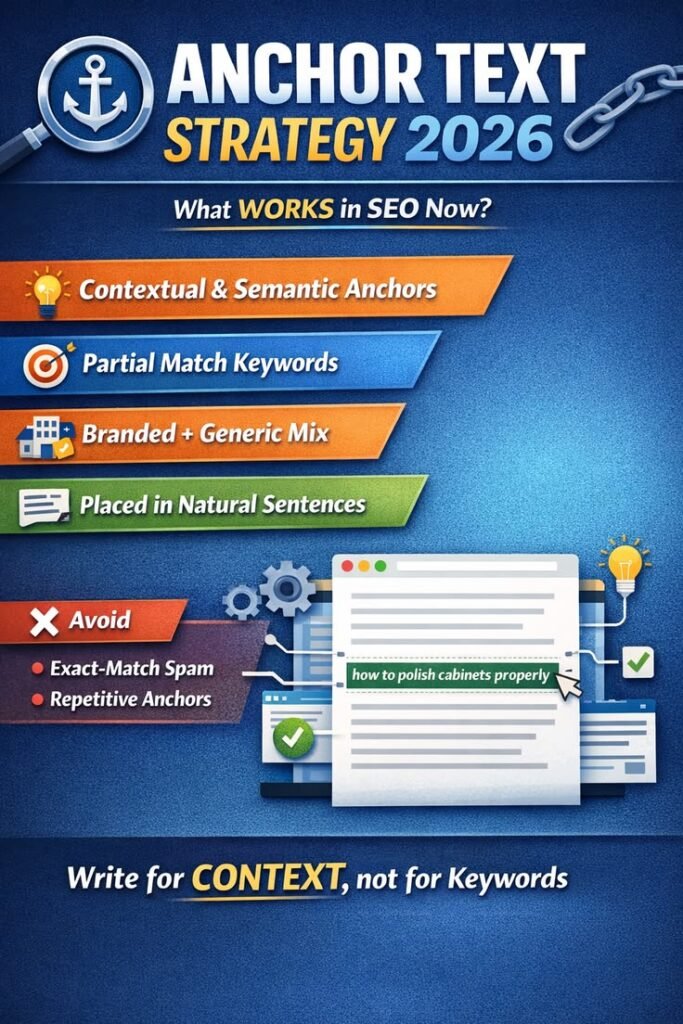
✔ Prioritize branded anchors
✔ Use partial-match anchors strategically
✔ Avoid exact-match overuse
✔ Optimize internal linking structure
✔ Maintain anchor diversity
✔ Monitor backlink profiles monthly
✔ Use contextual links, not forced placements
✔ Audit regularly with SEO tools
Conclusion
Anchor text optimization is no longer about stuffing keywords into links. It’s about balance, context, natural language, and authority building.
Search engines like Google reward:
-
Natural anchor distribution
-
Contextual relevance
-
Topical consistency
When done correctly, anchor text becomes one of the most powerful ranking levers in your SEO strategy