Table of Contents
ToggleBest Landing Page Optimization Strategies to Maximize Conversions in 2026
In the digital marketing world, traffic alone does not guarantee success. You can run high-budget ads, rank on the first page of Google, and attract thousands of visitors—but if your landing page is not optimized, conversions will remain low. This is where landing page optimization (LPO) becomes one of the most powerful growth strategies for businesses, marketers, and agencies.
Landing page optimization is the process of improving elements of a landing page to increase conversions, whether that conversion is a lead, sale, signup, download, or inquiry. In 2026, with rising ad costs and increased competition, optimizing landing pages is no longer optional—it is essential.
This in-depth guide covers the best landing page optimization strategies, real-world examples, psychological triggers, design principles, SEO considerations, and CRO best practices to help you consistently achieve higher conversion rates.
What Is Landing Page Optimization?
Landing page optimization is a data-driven approach to improving page performance by testing and refining design, copy, layout, CTAs, forms, and user experience. Unlike regular web pages, landing pages are built with one primary goal—conversion.
Common Landing Page Goals
-
Lead generation
-
Product sales
-
Webinar registrations
-
App downloads
-
Newsletter signups
-
Free trial requests
A well-optimized landing page eliminates distractions and guides users toward a single action.
Why Landing Page Optimization Matters in 2026
Here’s why businesses are investing heavily in landing page optimization:
-
Lower Cost Per Acquisition (CPA)
-
Higher ROI on Ads (Google Ads, Meta, LinkedIn)
-
Improved User Experience
-
Better SEO Engagement Metrics
-
Higher Trust and Credibility
According to industry benchmarks, optimized landing pages can increase conversion rates by up to 300% without increasing traffic.
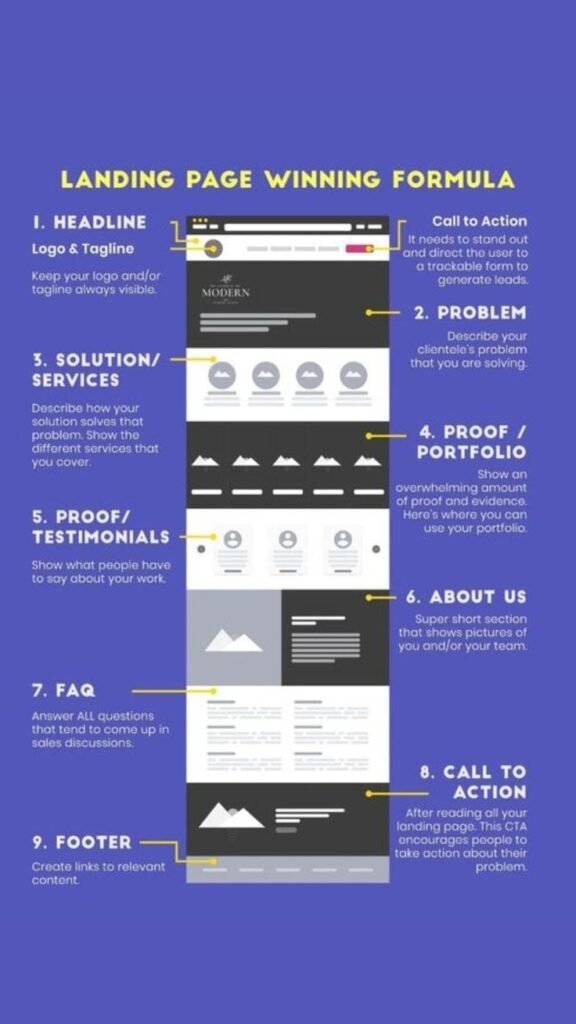
Key Elements of a High-Converting Landing Page
Before diving into strategies, it’s important to understand the core components of an optimized landing page.
1. Compelling Headline
Your headline is the first thing visitors see. It must:
-
Clearly state the value proposition
-
Address a specific pain point
-
Be simple and benefit-driven
Example:
“Get 3X More Leads With Our Proven Landing Page Framework”
2. Clear Value Proposition
Explain why your offer matters and how it solves the user’s problem. Avoid generic claims—be specific.
Bad: “Best Marketing Services”
Good: “Generate Qualified Leads in 30 Days Without Increasing Ad Spend”
3. Persuasive Subheadline
Support your headline by explaining how you deliver the promise.
4. Strong Call-to-Action (CTA)
Your CTA should:
-
Be action-oriented
-
Create urgency
-
Stand out visually
High-Converting CTA Examples:
-
Get My Free Audit
-
Start My Free Trial
-
Download the Guide
-
Book a Free Call
5. Optimized Visuals
Use images or videos that:
-
Show real people or product usage
-
Support the message, not distract
-
Improve emotional connection
Video landing pages often convert up to 80% higher than static pages.
Best Landing Page Optimization Strategies
1. Focus on One Conversion Goal
One landing page = one goal.
Avoid:
-
Multiple CTAs
-
Navigation menus
-
External links
Every element should push users toward one action only.
2. Improve Page Load Speed
Page speed is critical for both SEO and conversions.
Best Practices:
-
Compress images
-
Use modern formats (WebP)
-
Minimize JavaScript
-
Use fast hosting
-
Enable caching
Even a 1-second delay can reduce conversions by up to 7%.
3. Use Conversion-Focused Copywriting
Landing page copy should follow proven psychological frameworks.
AIDA Framework
-
Attention: Headline
-
Interest: Subheadline + visuals
-
Desire: Benefits, social proof
-
Action: CTA
PAS Framework
-
Problem: Identify pain
-
Agitate: Highlight consequences
-
Solution: Present your offer
4. Highlight Benefits, Not Features
Users care about outcomes, not specifications.
Feature: “AI-powered analytics”
Benefit: “Make smarter decisions with real-time insights”
5. Add Social Proof for Trust
Social proof reduces hesitation and increases credibility.
Types of Social Proof:
-
Customer testimonials
-
Star ratings
-
Case studies
-
Client logos
-
Reviews & ratings
-
Trust badges
Pages with testimonials convert 34% higher on average.
6. Optimize Forms for Higher Completion Rates
Forms are a major conversion barrier.
Form Optimization Tips:
-
Ask only essential fields
-
Use multi-step forms
-
Add inline validation
-
Use autofill
-
Place forms above the fold
Best Practice:
For lead generation, 3–5 fields perform best.
7. Use Above-the-Fold Optimization
Above the fold content should include:
-
Headline
-
Subheadline
-
CTA
-
Hero image/video
-
Key benefit
Users decide within 3 seconds whether to stay or leave.
8. Leverage Visual Hierarchy
Guide user attention using:
-
Contrast
-
White space
-
Font size
-
Button color
Your CTA should be the most visually prominent element.
9. Mobile-First Landing Page Design
Over 70% of traffic now comes from mobile devices.
Mobile Optimization Checklist:
-
Fast loading
-
Thumb-friendly buttons
-
Short paragraphs
-
Vertical layout
-
Click-to-call CTAs
Mobile-optimized pages significantly outperform desktop-only designs.
10. Use A/B Testing for Continuous Improvement
A/B testing compares two versions of a landing page to determine which performs better.
Test Elements:
-
Headlines
-
CTAs
-
Button colors
-
Form length
-
Images/videos
-
Layout
Never rely on assumptions—let data decide.
SEO Best Practices for Landing Page Optimization
While landing pages are conversion-focused, SEO still plays a major role.
1. Keyword Optimization
-
Use primary keyword in title, URL, H1
-
Add secondary keywords naturally
-
Avoid keyword stuffing
2. Meta Title & Description
Write compelling meta tags to improve CTR.
3. Internal Linking
Link to relevant blog posts or service pages (without distracting users).
4. Schema Markup
Use structured data for reviews, FAQs, and offers.
Psychological Triggers That Boost Conversions
1. Scarcity
“Only 5 slots left”
2. Urgency
“Offer expires in 24 hours”
3. Authority
Industry certifications, awards, expert endorsements
4. Reciprocity
Free guides, audits, or tools
5. Simplicity
Clear, distraction-free design builds confidence
Landing Page Optimization Mistakes to Avoid
❌ Too many CTAs
❌ Slow page speed
❌ Generic messaging
❌ No social proof
❌ Poor mobile experience
❌ Long forms
❌ Weak CTA copy
Avoiding these mistakes can instantly improve results.
Tools for Landing Page Optimization
Design & Builders
-
Unbounce
-
Instapage
-
Webflow
-
WordPress (Elementor, Gutenberg)
CRO & Testing
-
Google Optimize (alternatives)
-
VWO
-
Optimizely
Analytics & Tracking
-
Google Analytics 4
-
Hotjar
-
Microsoft Clarity
Real-World Example of Landing Page Optimization
A SaaS company reduced form fields from 7 to 4, added a customer testimonial near the CTA, improved headline clarity, and optimized page speed.
Result:
-
Conversion rate increased by 62%
-
Cost per lead dropped by 38%
Landing Page Optimization Checklist
✔ Clear headline & value proposition
✔ Single conversion goal
✔ Fast load speed
✔ Mobile-friendly design
✔ Strong CTA
✔ Optimized form
✔ Social proof
✔ SEO best practices
✔ A/B testing setup
Future Trends in Landing Page Optimization
-
AI-driven personalization
-
Dynamic content based on user intent
-
Voice search optimization
-
Interactive landing pages
Staying ahead of these trends will give you a competitive advantage.
Conclusion
Landing page optimization is not a one-time task—it is a continuous process of testing, analyzing, and improving. In 2026, businesses that prioritize conversion optimization will outperform competitors without increasing ad spend.
By implementing the best landing page optimization strategies outlined in this guide—clear messaging, strong CTAs, mobile-first design, social proof, and A/B testing—you can turn more visitors into leads, customers, and long-term brand advocates.