Table of Contents
ToggleThe Ultimate Guide to Product-Led Growth (PLG) in 2026
In today’s competitive digital landscape, traditional sales-driven strategies are no longer enough. Customers want to experience value before committing to a purchase. This shift has given rise to Product-Led Growth (PLG)—a powerful business model where the product itself becomes the primary driver of acquisition, conversion, and expansion.
In this comprehensive guide, you’ll learn everything about product-led growth, including strategies, frameworks, tools, examples, and best practices to scale your business in 2026 and beyond.
What is Product-Led Growth (PLG)?
Product-Led Growth (PLG) is a business strategy where the product is the main vehicle for:
- Customer acquisition
- User activation
- Retention
- Expansion
Instead of relying heavily on sales or marketing teams, PLG allows users to experience the product’s value firsthand—often through free trials, freemium models, or demos.
Why Product-Led Growth Matters
1. Lower Customer Acquisition Cost (CAC)
Users discover and adopt the product organically, reducing marketing spend.
2. Faster Scaling
Products can reach millions without proportional increases in sales teams.
3. Better User Experience
Customers understand value through direct interaction.
4. Higher Retention Rates
Users who find value are more likely to stay.
5. Data-Driven Insights
User behavior provides valuable data for optimization.
Key Principles of Product-Led Growth
1. Value First
Deliver value to users before asking for payment.
2. Seamless Onboarding
Ensure users can quickly understand and use the product.
3. Self-Service Experience
Allow users to explore and use the product without friction.
4. Continuous Optimization
Use data to improve product experience.
5. User-Centric Design
Focus on solving real user problems.
Product-Led Growth vs Traditional Growth
| Aspect | Product-Led Growth | Sales-Led Growth |
|---|---|---|
| Driver | Product | Sales team |
| Acquisition | Self-service | Sales outreach |
| Cost | Lower | Higher |
| Speed | Faster | Slower |
| Scalability | High | Limited |
The Product-Led Growth Funnel
1. Acquisition
Users discover your product through:
- SEO
- Content marketing
- Referrals
2. Activation
Users experience the core value quickly.
3. Engagement
Users continue using the product regularly.
4. Conversion
Free users upgrade to paid plans.
5. Expansion
Existing users upgrade or refer others.
Best Product-Led Growth Strategies
1. Freemium Model
Offer a free version with limited features to attract users.
Benefits:
- Low entry barrier
- High adoption rate
2. Free Trials
Allow users to experience premium features for a limited time.
3. Product Demos
Interactive demos help users understand value quickly.
4. Viral Loops
Encourage users to invite others.
Example:
- Referral incentives
- Shareable features
5. In-Product Upselling
Promote upgrades within the product experience.
6. Personalization
Customize user experience based on behavior.
7. Data-Driven Optimization
Analyze user data to improve:
- Onboarding
- Features
- Engagement
Designing a PLG Product
1. Intuitive User Interface
Make the product easy to use.
2. Fast Time-to-Value (TTV)
Help users achieve results quickly.
3. Clear Value Proposition
Communicate benefits effectively.
4. Feedback Loops
Collect user feedback continuously.
5. Scalable Architecture
Ensure the product can handle growth.
Tools for Product-Led Growth
1. Analytics Platforms
- Google Analytics
2. Product Analytics
- Mixpanel
- Amplitude
3. CRM Systems
- HubSpot
- Salesforce
4. User Engagement Tools
- In-app messaging
- Push notifications
5. A/B Testing Tools
Optimize product features and experiences.
Metrics for Product-Led Growth
1. Activation Rate
Percentage of users experiencing core value.
2. Retention Rate
How many users continue using the product.
3. Churn Rate
Users who stop using the product.
4. Customer Lifetime Value (CLV)
Total revenue generated per user.
5. Net Promoter Score (NPS)
Customer satisfaction and loyalty.
Common Challenges in PLG
1. Poor Onboarding
Users fail to see value quickly.
2. Lack of Product-Market Fit
Product doesn’t meet user needs.
3. Complex User Experience
Confuses users and reduces engagement.
4. Limited Monetization Strategy
Difficulty converting free users to paid.
5. Data Misinterpretation
Incorrect insights lead to poor decisions.
Best Practices for PLG Success
1. Focus on User Experience
Simplify navigation and usability.
2. Optimize Onboarding
Guide users step-by-step.
3. Use Behavioral Data
Personalize experiences based on actions.
4. Encourage User Feedback
Continuously improve product features.
5. Align Teams
Ensure product, marketing, and sales work together.
Advanced PLG Techniques
1. AI-Powered Personalization
Use AI to tailor user experiences.
2. Predictive Analytics
Anticipate user behavior and needs.
3. Gamification
Use rewards and achievements to increase engagement.
4. Community Building
Create user communities for support and engagement.
5. Ecosystem Integration
Integrate with other tools and platforms.
Real-World Examples of PLG
SaaS Example
A software company offers a freemium version.
Strategy:
- Free access
- In-product upgrades
- Referral incentives
Result:
- Rapid user growth
- High conversion rates
Future Trends in Product-Led Growth
1. AI Integration
Automation and personalization will improve user experience.
2. Hyper-Personalization
Tailored experiences for each user.
3. No-Code and Low-Code Platforms
Faster product development and iteration.
4. Customer-Centric Innovation
Products will evolve based on user feedback.
5. Global Scalability
Digital products will reach worldwide audiences.
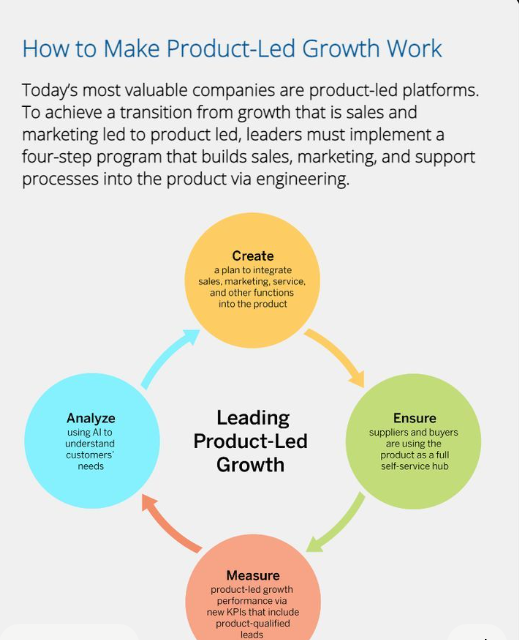
Step-by-Step PLG Implementation Plan
Step 1: Identify Target Audience
Understand user needs and pain points.
Step 2: Build a Valuable Product
Focus on solving real problems.
Step 3: Design Onboarding Experience
Help users achieve value quickly.
Step 4: Launch Freemium or Trial Model
Encourage product adoption.
Step 5: Track User Behavior
Use analytics tools for insights.
Step 6: Optimize Continuously
Improve product based on data.
Conclusion
Product-Led Growth is transforming how businesses scale in the digital age. By focusing on delivering value through the product itself, companies can achieve rapid growth, lower acquisition costs, and higher customer satisfaction.