Table of Contents
ToggleBest SEO Domain Authority Improvement Guide: The Complete 3000-Word Strategy to Increase Website Authority
In the competitive world of digital marketing, ranking higher in search engines requires more than just publishing content. Search engines evaluate the credibility, trustworthiness, and authority of websites before ranking them. One of the most widely used metrics to measure website strength is Domain Authority (DA).
Improving domain authority can significantly boost your website’s ability to rank higher in search results, attract organic traffic, and outperform competitors. Websites with strong domain authority tend to rank more easily for competitive keywords and gain better visibility online.
In this comprehensive guide, you will learn what domain authority is, why it matters for SEO, and the best strategies to improve your website’s authority effectively.
What is Domain Authority?
Domain Authority (DA) is a search engine ranking score that predicts how likely a website is to rank in search engine results pages (SERPs). The score typically ranges from 1 to 100, with higher scores indicating stronger ranking potential.
Websites with high domain authority generally have:
-
Strong backlink profiles
-
High-quality content
-
Established online presence
-
Strong technical SEO
-
Consistent traffic
While domain authority itself is not a direct ranking factor used by search engines, it reflects the overall SEO strength of a website.
Why Domain Authority is Important for SEO
Improving domain authority can bring several benefits for websites and businesses.
Higher Search Engine Rankings
Websites with higher authority tend to rank higher in search results compared to weaker sites targeting the same keywords.
Increased Organic Traffic
Better rankings lead to more visibility and increased organic traffic from search engines.
Improved Trust and Credibility
High-authority websites appear more trustworthy to both search engines and users.
Better Link Opportunities
Websites with strong authority are more likely to attract backlinks from other reputable websites.
Competitive Advantage
Improving domain authority helps you compete with established websites in your industry.
Factors That Influence Domain Authority
Several SEO factors influence domain authority.
Understanding these factors helps improve your website’s overall performance.
Quality Backlinks
Backlinks from reputable websites significantly increase domain authority.
High-quality links signal trust and credibility to search engines.
Content Quality
Publishing valuable and informative content attracts both users and backlinks.
High-quality content helps build topical authority.
Website Structure
A well-structured website improves user experience and search engine crawling.
Proper internal linking helps distribute authority across pages.
Technical SEO
Technical factors such as site speed, mobile optimization, and secure connections also impact website authority.
Domain Age
Older domains often have stronger authority because they have accumulated backlinks over time.
Best Strategies to Improve Domain Authority
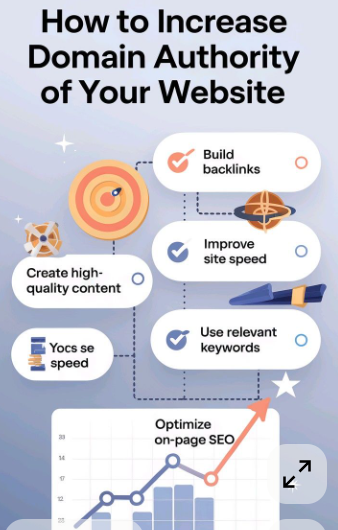
Improving domain authority requires a long-term SEO strategy. The following methods are among the most effective techniques.
1. Build High-Quality Backlinks
Backlinks remain one of the most important factors influencing domain authority.
However, not all backlinks are equal.
Focus on acquiring links from:
-
High-authority websites
-
Relevant industry blogs
-
Trusted news websites
-
Educational platforms
Quality matters more than quantity when building backlinks.
2. Create High-Quality Content
Content is the foundation of SEO success.
Publishing valuable content increases the chances of attracting backlinks and organic traffic.
Examples of high-performing content include:
-
In-depth guides
-
Research articles
-
Case studies
-
Tutorials
-
Industry insights
Comprehensive content often performs better in search rankings.
3. Focus on Long-Form Content
Long-form content tends to rank higher because it provides detailed information.
Articles between 1500 and 3000 words often attract more backlinks and engagement.
These articles can cover topics more thoroughly and answer user questions effectively.
4. Improve Internal Linking
Internal linking helps distribute authority throughout your website.
Benefits of internal linking include:
-
Better site navigation
-
Improved crawlability
-
Increased page authority
Link related articles together to strengthen topic relevance.
5. Remove Toxic Backlinks
Not all backlinks benefit your website.
Low-quality or spammy links can harm your SEO performance.
Regularly analyze your backlink profile and remove harmful links if necessary.
Maintaining a clean backlink profile helps protect your website authority.
6. Optimize On-Page SEO
On-page SEO ensures that search engines can easily understand your content.
Important on-page factors include:
-
Keyword optimization
-
Title tags
-
Meta descriptions
-
Header tags
-
Image optimization
Proper on-page optimization improves search visibility.
7. Improve Website Speed
Page speed is a critical factor for both user experience and SEO.
Slow websites often lose visitors and rankings.
Improving speed can be achieved by:
-
Compressing images
-
Reducing unnecessary scripts
-
Using fast hosting services
-
Implementing caching
Faster websites perform better in search results.
8. Make Your Website Mobile Friendly
Mobile optimization is essential because most internet users access websites through mobile devices.
Search engines prioritize mobile-friendly websites in rankings.
Ensure that your website:
-
Loads quickly on mobile
-
Has responsive design
-
Provides easy navigation
Mobile optimization improves user experience and SEO performance.
9. Publish Guest Posts
Guest blogging is a powerful strategy for gaining high-quality backlinks.
Writing articles for other reputable websites allows you to reach new audiences while building links to your own site.
Choose websites that are relevant to your niche and have strong authority.
Guest posts should provide real value rather than promotional content.
10. Promote Your Content
Creating great content is not enough.
Promotion helps increase visibility and attract backlinks.
Promote content through:
-
Social media platforms
-
Email newsletters
-
Online communities
-
Influencer outreach
Effective promotion increases the chances of gaining backlinks and traffic.
11. Improve User Experience
User experience plays an important role in website performance.
A well-designed website encourages visitors to stay longer and explore more pages.
Key factors include:
-
Clean design
-
Easy navigation
-
Fast loading speed
-
Engaging content
Positive user experience signals quality to search engines.
12. Use Content Clusters
Content clusters involve creating multiple articles around a central topic.
Example:
Main topic: Digital Marketing
Supporting articles:
SEO strategies
Social media marketing
Email marketing
Content marketing
This structure builds topical authority and improves SEO performance.
Domain Authority Improvement Timeline
Improving domain authority is not an instant process.
Results usually appear gradually over several months.
Typical timeline:
First 3 months
Content creation and backlink building
3 to 6 months
Gradual improvements in traffic and rankings
6 to 12 months
Significant authority growth with consistent SEO efforts
Patience and consistency are essential for long-term success.
Common Domain Authority Mistakes
Many website owners make mistakes that slow down their SEO progress.
Buying Low-Quality Backlinks
Cheap backlinks from spam websites can harm your SEO.
Focus on earning natural links instead.
Publishing Low-Quality Content
Thin or poorly written content does not attract backlinks or engagement.
Always prioritize quality over quantity.
Ignoring Technical SEO
Technical issues such as broken links or slow loading speeds can affect website authority.
Regular technical audits help maintain SEO performance.
Inconsistent Content Publishing
Irregular content updates reduce growth opportunities.
Consistency helps build authority over time.
Advanced Domain Authority Strategies
Experienced SEO professionals use advanced strategies to strengthen website authority.
Create Linkable Assets
Linkable assets are content pieces designed to attract backlinks.
Examples include:
Research reports
Infographics
Industry statistics
Comprehensive guides
These resources often attract natural backlinks from other websites.
Build Relationships with Influencers
Networking with industry influencers increases content visibility.
Influencers may share or link to your content if it provides value.
Collaborations help expand reach and credibility.
Leverage Data-Driven Content
Content supported by data and statistics often attracts more backlinks.
Original research and surveys provide unique insights that other websites may reference.
Repurpose Content
Repurposing content into different formats increases reach.
Examples include:
Blog posts converted into videos
Infographics from research articles
Podcasts from written content
Repurposing helps maximize content value.
Future Trends in Domain Authority and SEO
SEO continues to evolve as search engines improve their algorithms.
Future trends include:
Artificial intelligence in search ranking
Greater emphasis on user experience
Growth of voice search optimization
Increased importance of topical authority
Stronger focus on content quality
Websites that adapt to these changes will maintain strong domain authority.
Conclusion
Domain authority improvement is a long-term SEO strategy that requires consistent effort and smart optimization. By focusing on high-quality backlinks, valuable content, strong technical SEO, and excellent user experience, websites can gradually increase their authority and achieve better search rankings.
Rather than relying on shortcuts or quick fixes, successful SEO strategies prioritize sustainable growth and trust-building. Websites that provide genuine value to users and maintain strong online credibility will continue to grow their authority over time.