Table of Contents
ToggleBest Startup Marketing Automation: A Complete Guide to Scaling Growth
Startup founders face one major challenge: growing fast with limited resources. Marketing automation has become a powerful solution that allows startups to reach customers, nurture leads, and increase conversions without increasing workload.
In today’s digital world, automation tools and platforms such as HubSpot, Mailchimp, ActiveCampaign, and Zapier help startups streamline marketing tasks and focus on growth.
This comprehensive guide explains startup marketing automation, its benefits, strategies, tools, and best practices to help your startup scale effectively.
What is Startup Marketing Automation?
Startup marketing automation refers to using software tools and technology to automatically manage marketing processes, campaigns, and customer interactions across multiple channels.
Instead of manually sending emails, posting on social media, or tracking leads, automation tools handle repetitive tasks.
Common automated marketing tasks include:
-
Email campaigns
-
Lead nurturing
-
Social media scheduling
-
Customer segmentation
-
CRM updates
-
Sales funnel tracking
-
Ad campaign optimization
For startups with small teams, marketing automation ensures consistent marketing performance without hiring large teams.
Why Marketing Automation is Important for Startups
Startups operate in competitive environments where speed, efficiency, and data-driven decisions are critical. Marketing automation helps startups compete with larger companies.
1. Saves Time and Resources
Automation eliminates repetitive marketing tasks like sending emails or updating lead databases. This allows founders and marketing teams to focus on strategy, innovation, and growth.
2. Improves Lead Generation
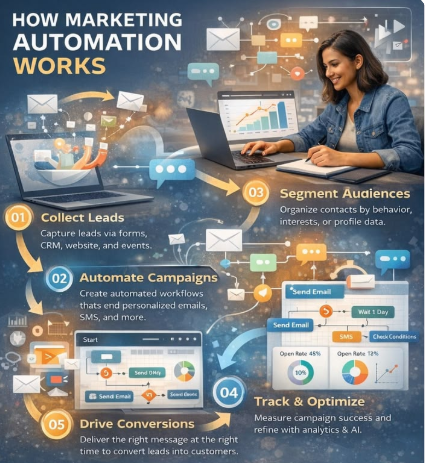
Automation tools capture leads through forms, landing pages, and chatbots and automatically add them to marketing campaigns.
Platforms like HubSpot provide lead scoring features that identify high-value prospects.
3. Enhances Customer Experience
Automated marketing delivers personalized content and messages based on user behavior.
For example:
-
Welcome emails
-
Product recommendations
-
Follow-up messages
Tools like Mailchimp help create personalized email sequences.
4. Increases Conversion Rates
Automated workflows guide prospects through the sales funnel, increasing the likelihood of conversions.
Platforms such as ActiveCampaign enable advanced customer journey automation.
5. Provides Data Insights
Automation tools provide analytics and reporting that help startups understand:
-
Customer behavior
-
Campaign performance
-
Conversion rates
This allows startups to make data-driven marketing decisions.
Key Components of Startup Marketing Automation
To build an effective automation system, startups must focus on the following components.
1. Lead Generation Automation
Lead generation is the foundation of startup marketing.
Automation tools capture leads through:
-
Landing pages
-
Email signups
-
Social media ads
-
Website forms
-
Chatbots
For example, startups often integrate forms with CRM systems like HubSpot to automatically store lead information.
2. Email Marketing Automation
Email remains one of the most effective marketing channels.
Automated email sequences include:
-
Welcome emails
-
Onboarding emails
-
Product education emails
-
Promotional offers
-
Cart abandonment emails
Tools like Mailchimp and ActiveCampaign provide powerful email automation capabilities.
3. Customer Segmentation
Segmentation helps startups send relevant messages to the right audience.
Customers can be segmented based on:
-
Demographics
-
Purchase history
-
Website activity
-
Engagement level
-
Location
Automation platforms automatically group customers into segments and trigger relevant campaigns.
4. Social Media Automation
Social media marketing is essential for brand visibility.
Automation tools schedule posts, analyze performance, and manage campaigns across platforms like:
-
Instagram
-
LinkedIn
-
Facebook
Scheduling tools allow startups to plan content weeks or months in advance.
5. Sales Funnel Automation
Marketing automation connects marketing and sales processes.
Typical automated funnel stages include:
-
Awareness
-
Interest
-
Consideration
-
Conversion
-
Retention
Automation ensures that every lead receives targeted messages based on their funnel stage.
Best Startup Marketing Automation Tools
Choosing the right automation tools is critical for startup success.
1. HubSpot
HubSpot is one of the most popular marketing automation platforms for startups.
Features include:
-
CRM integration
-
Email automation
-
Lead scoring
-
Landing page builder
-
Analytics dashboards
HubSpot also offers a free CRM, making it ideal for early-stage startups.
2. Mailchimp
Mailchimp is widely used for email marketing automation.
Key features:
-
Automated email campaigns
-
Audience segmentation
-
Marketing analytics
-
Landing page creation
It is beginner-friendly and suitable for startups with small budgets.
3. ActiveCampaign
ActiveCampaign focuses on customer experience automation.
Features include:
-
Advanced workflow automation
-
CRM integration
-
Behavioral tracking
-
Email personalization
This platform is ideal for startups focusing on customer journey optimization.
4. Zapier
Zapier connects multiple apps and automates workflows without coding.
Example automation:
-
Add new leads from Facebook Ads to CRM
-
Send Slack notifications for new customers
-
Sync data between marketing platforms
Zapier integrates with 5000+ apps, making it a powerful automation tool.
Startup Marketing Automation Strategies
Implementing automation requires a strategic approach.
1. Build Automated Lead Funnels
Startups should design automated lead funnels that guide prospects from awareness to purchase.
Example funnel:
Ad → Landing Page → Email Capture → Email Sequence → Product Offer → Conversion
2. Use Behavioral Triggers
Behavioral triggers send messages based on user actions.
Examples:
-
Website visit triggers follow-up email
-
Cart abandonment triggers reminder email
-
Product view triggers recommendation email
This increases engagement and conversions.
3. Create Automated Content Marketing
Content marketing can also be automated.
Examples include:
-
Automated blog promotion
-
Email newsletters
-
Social media scheduling
-
Content distribution
Automation ensures consistent content delivery.
4. Implement Lead Scoring
Lead scoring assigns points to prospects based on their engagement level.
Examples:
-
Email open: +5 points
-
Website visit: +10 points
-
Demo request: +20 points
Platforms like HubSpot help identify high-value leads ready for sales contact.
5. Personalize Marketing Campaigns
Personalization significantly improves marketing results.
Automation tools personalize:
-
Email subject lines
-
Product recommendations
-
Website content
Customers respond better to personalized experiences.
Benefits of Startup Marketing Automation
Marketing automation provides numerous advantages for startups.
Increased Efficiency
Automation reduces manual work and improves productivity.
Better Lead Management
Leads are automatically captured, tracked, and nurtured.
Improved Customer Engagement
Personalized marketing messages improve engagement.
Higher Revenue
Automation helps convert leads into paying customers faster.
Scalable Growth
Startups can scale marketing campaigns without expanding teams.
Challenges of Marketing Automation
Despite its benefits, startups may face challenges.
Tool Complexity
Some automation tools have steep learning curves.
Initial Setup Time
Creating workflows and automation sequences requires planning and testing.
Data Quality Issues
Automation works best when customer data is accurate and well-organized.
Best Practices for Startup Marketing Automation
Startups should follow these best practices for successful automation.
Start Small
Begin with simple automation such as:
-
Welcome email sequences
-
Lead capture forms
-
Social media scheduling
Gradually expand automation workflows.
Focus on Customer Journey
Automation should support the entire customer journey, from awareness to retention.
Use Analytics and Testing
Continuously test marketing campaigns to improve results.
Important metrics include:
-
Email open rates
-
Click-through rates
-
Conversion rates
-
Customer acquisition cost
Integrate Marketing and Sales
Automation should connect marketing with sales processes.
CRM platforms such as HubSpot help align marketing and sales teams.
Future of Startup Marketing Automation
Marketing automation is evolving rapidly with new technologies.
Emerging trends include:
AI-Powered Marketing Automation
Artificial intelligence helps analyze customer behavior and predict conversions.
Chatbot Automation
AI chatbots automatically answer customer questions and capture leads.
Omnichannel Automation
Automation platforms now support marketing across multiple channels.
Predictive Analytics
Data-driven insights help startups forecast marketing results.
Automation tools will continue to transform how startups acquire and retain customers.
Conclusion
Startup marketing automation has become essential for businesses aiming to grow efficiently in competitive digital markets. By automating repetitive marketing tasks, startups can focus on strategy, innovation, and customer experience.
Platforms such as HubSpot, Mailchimp, ActiveCampaign, and Zapier provide powerful solutions that help startups manage campaigns, nurture leads, and increase conversions.
If you want, I can also help you with: