Table of Contents
ToggleBest Google Ranking Factors: The Ultimate Guide to SEO Success
Introduction
Ranking on Google is the ultimate goal for any website aiming to generate organic traffic, leads, and revenue. With billions of searches happening every day, appearing on the first page of Google can dramatically impact your business growth. However, achieving top rankings is not about luck—it’s about understanding and optimizing for Google’s ranking factors.
Google uses hundreds of ranking signals to determine which pages appear at the top of search results. While the exact algorithm is constantly evolving, there are well-established factors that consistently influence rankings.
This comprehensive guide explores the most important Google ranking factors in 2026 and how you can optimize your website to achieve higher visibility and better ROI.
What Are Google Ranking Factors?
Google ranking factors are criteria used by search engines to evaluate and rank web pages in search results. These factors help Google determine:
- Relevance of content
- Quality of information
- User experience
- Authority of the website
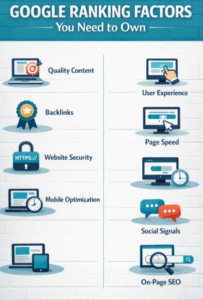
1. High-Quality Content (Most Important Factor)
Content remains the foundation of SEO.
What Makes Content High-Quality?
- Original and unique
- Valuable and informative
- Well-structured and readable
- Matches search intent
Types of Content That Rank Well:
- Long-form guides
- How-to articles
- Listicles
- Case studies
Pro Tip:
Focus on solving user problems rather than just inserting keywords.
2. Search Intent Optimization
Google prioritizes content that satisfies user intent.
Types of Search Intent:
- Informational
- Navigational
- Transactional
- Commercial
Optimization Strategy:
Analyze top-ranking pages and align your content accordingly.
3. Keyword Optimization
Keywords help Google understand your content.
Best Practices:
- Use primary keyword in title, URL, and headings
- Include secondary keywords naturally
- Avoid keyword stuffing
Semantic SEO:
Use related terms and synonyms to improve context.
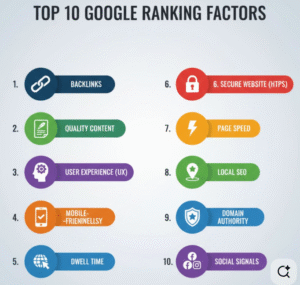
4. Backlinks (Authority Signal)
Backlinks are one of the strongest ranking factors.
What Are Backlinks?
Links from other websites pointing to your site.
High-Quality Backlinks:
- From authoritative websites
- Relevant to your niche
- Natural and organic
Strategy:
- Guest posting
- PR outreach
- Content marketing
5. Page Experience (Core Web Vitals)
User experience is a critical ranking factor.
Core Web Vitals Include:
- Largest Contentful Paint (LCP)
- First Input Delay (FID)
- Cumulative Layout Shift (CLS)
Optimization Tips:
- Improve page speed
- Optimize images
- Use responsive design
6. Mobile-Friendliness
Google uses mobile-first indexing.
Why It Matters:
Most users browse on mobile devices.
Best Practices:
- Responsive design
- Fast mobile loading
- Easy navigation
7. Page Speed
Faster websites rank better.
Tools to Measure Speed:
- Google PageSpeed Insights
- GTmetrix
Optimization Techniques:
- Minimize CSS/JS
- Use caching
- Optimize images
8. On-Page SEO
On-page optimization ensures that your content is search-engine friendly.
Key Elements:
- Title tags
- Meta descriptions
- Header tags (H1, H2, H3)
- Internal linking
9. Technical SEO
Technical SEO ensures that search engines can crawl and index your site effectively.
Key Components:
- XML sitemap
- Robots.txt
- Canonical tags
- Structured data
10. Domain Authority
Domain authority reflects your website’s overall credibility.
Factors Influencing Authority:
- Backlinks
- Content quality
- Website age
11. User Engagement Metrics
Google considers how users interact with your site.
Important Metrics:
- Click-through rate (CTR)
- Bounce rate
- Dwell time
Strategy:
Create engaging and relevant content.
12. Internal Linking
Internal links help distribute authority across your website.
Benefits:
- Improves navigation
- Enhances crawlability
- Boosts SEO
13. Secure Website (HTTPS)
Security is a ranking factor.
Why HTTPS Matters:
- Protects user data
- Builds trust
- Improves rankings
14. Fresh Content
Regularly updated content performs better.
Strategy:
- Update old posts
- Add new information
- Refresh statistics
15. Featured Snippets Optimization
Featured snippets appear at the top of search results.
Optimization Tips:
- Use bullet points
- Answer questions clearly
- Structure content properly
16. Voice Search Optimization
Voice search is growing rapidly.
Strategy:
- Use conversational keywords
- Focus on long-tail queries
- Optimize for questions
17. Local SEO Signals
For local businesses, local SEO is critical.
Key Factors:
- Google Business Profile
- Local citations
- Reviews
18. E-E-A-T (Experience, Expertise, Authoritativeness, Trustworthiness)
Google prioritizes trustworthy content.
How to Improve E-E-A-T:
- Showcase expertise
- Add author bios
- Use credible sources
19. Image Optimization
Images enhance user experience and SEO.
Best Practices:
- Use alt text
- Compress images
- Use descriptive file names
20. URL Structure
Clean URLs improve rankings.
Example:
Good: yourwebsite.com/seo-guide
Bad: yourwebsite.com/page?id=123
21. Social Signals (Indirect Factor)
Social media does not directly impact rankings but increases visibility.
22. Content Depth and Length
Longer content tends to rank better when it provides value.
Ideal Length:
1000–3000 words depending on topic.
23. Schema Markup
Structured data helps search engines understand your content.
24. Crawlability and Indexing
Ensure your site is easily crawlable.
25. Avoiding Duplicate Content
Duplicate content can harm rankings.
Common SEO Mistakes to Avoid
- Keyword stuffing
- Buying low-quality backlinks
- Ignoring mobile optimization
- Slow website speed
- Thin content
Future of Google Ranking Factors
- AI-driven search algorithms
- Increased focus on user experience
- Voice and visual search
- First-party data importance
Conclusion
Google ranking factors are constantly evolving, but the core principles remain the same: quality, relevance, and user experience. By focusing on high-quality content, strong backlinks, technical optimization, and user engagement, you can significantly improve your search rankings.
SEO is not a one-time effort—it requires continuous optimization, monitoring, and adaptation. Businesses that invest in understanding and implementing these ranking factors will achieve long-term success and sustainable growth.
Final Takeaways
- Content is king—focus on quality and relevance
- Build strong backlinks
- Optimize for mobile and speed
- Improve user experience
- Continuously update and optimize