Table of Contents
ToggleBest Welcome Email Sequence: The Complete Guide to Creating High-Converting Welcome Emails (3000 Words)
Email marketing remains one of the most powerful digital marketing channels for businesses. When someone subscribes to your email list, it creates a valuable opportunity to introduce your brand, build trust, and guide subscribers toward becoming customers. This first interaction is known as a welcome email sequence.
A well-crafted welcome email sequence helps businesses engage new subscribers, explain their brand value, and encourage future actions such as purchases or sign-ups. Many successful companies use welcome sequences to nurture relationships with customers from the very beginning.
Popular email marketing platforms like Mailchimp, HubSpot, and Klaviyo provide automation tools that make it easy to create effective welcome email campaigns.
In this guide, you will learn everything about creating the best welcome email sequence, including strategies, examples, and best practices.
What Is a Welcome Email Sequence?
A welcome email sequence is a series of automated emails sent to new subscribers after they join your email list.
Instead of sending only one email, businesses often send multiple emails over several days to build a stronger connection with subscribers.
Typical goals of a welcome email sequence include:
-
Introducing the brand
-
Delivering promised resources or offers
-
Building trust with subscribers
-
Encouraging engagement
-
Driving the first conversion
These emails are usually triggered automatically through marketing automation platforms.
Why Welcome Email Sequences Are Important
Welcome emails often achieve significantly higher engagement compared to regular marketing emails.
Here are some key benefits.
1. Higher Open Rates
Welcome emails often have open rates of 50% or more, much higher than typical marketing emails.
Subscribers are most interested immediately after joining your list.
2. Strong First Impression
The welcome email sequence is your first opportunity to make a positive impression on new subscribers.
A professional and friendly introduction helps establish credibility.
3. Builds Brand Trust
Introducing your brand story and values helps subscribers understand who you are and what you offer.
Trust is essential for long-term customer relationships.
4. Guides Subscribers Through the Customer Journey
A welcome sequence can guide subscribers through important steps such as:
-
Learning about your products
-
Exploring useful content
-
Making their first purchase
5. Increases Conversion Rates
By gradually introducing value and offers, welcome sequences often lead to higher conversion rates.
Subscribers become more comfortable with your brand before making purchasing decisions.
Structure of an Effective Welcome Email Sequence
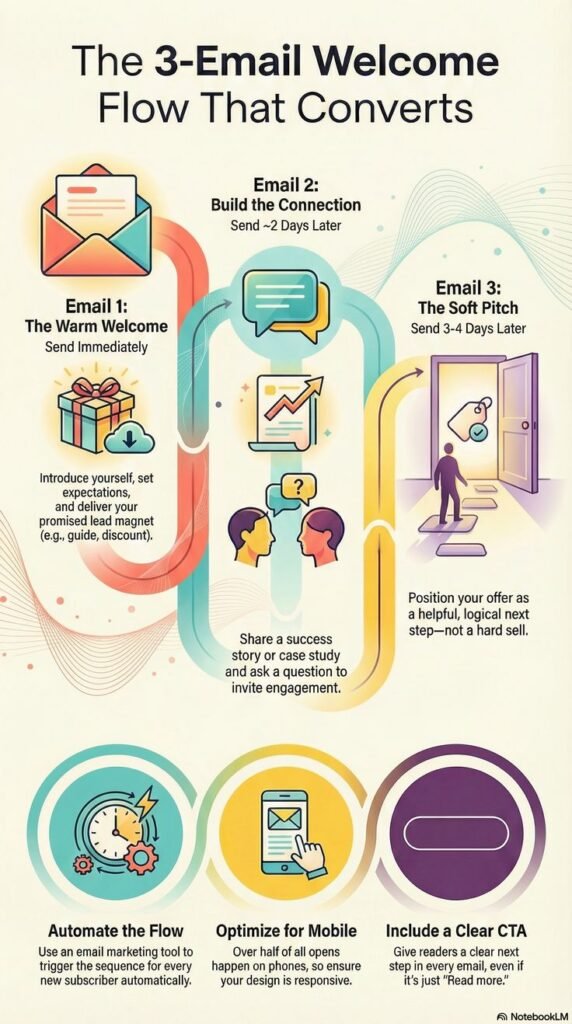
An effective welcome email sequence usually consists of 4–6 emails sent over several days.
Here is a common structure.
Email 1: Welcome and Thank You
The first email should thank subscribers for joining and deliver any promised resources.
Content may include:
-
Welcome message
-
Introduction to your brand
-
Download links for lead magnets
-
Expectations for future emails
Example subject lines:
-
Welcome to Our Community
-
Thanks for Joining Us
-
Your Free Guide Is Here
Email 2: Brand Introduction
The second email should introduce your brand story.
This email helps subscribers connect with your mission and values.
Include information such as:
-
Why the brand was created
-
What problems you solve
-
Your brand philosophy
Storytelling makes this email more engaging.
Email 3: Provide Valuable Content
The third email should provide educational or helpful content.
Examples include:
-
Blog posts
-
Tutorials
-
Industry insights
-
Helpful resources
Providing value early builds trust with subscribers.
Email 4: Showcase Products or Services
After building trust, introduce your products or services.
Explain:
-
Key features
-
Benefits
-
Customer success stories
Focus on solving problems rather than aggressive selling.
Email 5: Social Proof and Testimonials
Social proof helps increase credibility.
Include:
-
Customer testimonials
-
Case studies
-
Product reviews
Seeing positive feedback from others encourages subscribers to trust your brand.
Email 6: Special Offer or Call-to-Action
The final email can encourage action.
Examples include:
-
Limited-time discount
-
Free trial
-
Product demonstration
-
Consultation booking
This email often converts interested subscribers into customers.
Key Elements of a High-Converting Welcome Email
Creating effective welcome emails requires several important elements.
Personalized Greeting
Personalization makes emails feel more human.
Many email platforms such as Mailchimp allow businesses to include subscriber names automatically.
Example:
“Hi John, welcome to our community!”
Engaging Subject Lines
Subject lines determine whether subscribers open the email.
Effective subject lines are:
-
Short
-
Clear
-
Curiosity-driven
Example subject lines:
-
Welcome! Here’s What Happens Next
-
Your Free Marketing Guide Is Inside
-
Start Your Journey With Us
Clear Call-to-Action
Every email should encourage a specific action.
Examples include:
-
Read our blog
-
Explore our products
-
Download the guide
-
Join the community
Clear CTAs improve engagement.
Mobile-Friendly Design
Most people check emails on mobile devices.
Ensure your emails:
-
Use responsive design
-
Include readable text
-
Have clickable buttons
Platforms like HubSpot provide mobile-optimized email templates.
Visual Elements
Adding images and branding improves email design.
Include:
-
Brand logo
-
Product images
-
Illustrations
Visual elements make emails more appealing.
Best Tools for Creating Welcome Email Sequences
Several email marketing platforms help businesses automate welcome email sequences.
Mailchimp
Mailchimp is one of the most popular email marketing tools.
Features include:
-
Email automation
-
Audience segmentation
-
Analytics and reporting
HubSpot
HubSpot offers powerful marketing automation tools.
Benefits include:
-
Advanced personalization
-
CRM integration
-
Automated workflows
Klaviyo
Klaviyo is widely used by e-commerce businesses.
It provides detailed customer data and powerful automation features.
ActiveCampaign
ActiveCampaign offers advanced automation and segmentation features for sophisticated email campaigns.
Best Practices for Welcome Email Sequences
Follow these practices to improve your welcome email performance.
Send the First Email Immediately
The first email should be sent instantly after subscription.
Immediate communication confirms that the subscription was successful.
Keep Emails Short and Clear
Avoid overwhelming subscribers with too much information.
Focus on one message per email.
Deliver Value Before Selling
Build trust first by providing helpful information.
Promotional content should appear later in the sequence.
Use Automation
Email automation ensures consistent delivery of your welcome sequence.
Automation tools from Mailchimp or HubSpot make this process efficient.
Test and Optimize Emails
A/B testing helps identify the most effective email content.
Test elements such as:
-
Subject lines
-
Email layout
-
Call-to-action buttons
Continuous optimization improves results.
Metrics to Track in Welcome Email Campaigns
Measuring performance helps improve your email marketing strategy.
Key metrics include:
Open Rate
Percentage of subscribers who open your email.
Click-Through Rate
Percentage of users who click links in the email.
Conversion Rate
Percentage of subscribers who complete a desired action.
Unsubscribe Rate
Measures how many subscribers leave your email list.
Analytics tools in platforms like Klaviyo provide detailed insights.
Common Welcome Email Mistakes
Avoid these mistakes when designing your welcome sequence.
Sending Too Many Emails
Too many emails can overwhelm subscribers.
Limit your sequence to 4–6 emails.
Focusing Only on Sales
Aggressive selling in early emails can drive subscribers away.
Focus on value and relationship building first.
Ignoring Personalization
Generic emails feel less engaging.
Use personalization to improve connection with subscribers.
Poor Email Design
Unattractive or confusing designs reduce engagement.
Ensure your emails are visually appealing and easy to read.
Future of Welcome Email Sequences
Email marketing continues to evolve with new technologies.
Artificial intelligence and advanced automation are improving email personalization.
Companies like Google and Microsoft are investing in AI-driven marketing tools that analyze user behavior and optimize campaigns automatically.
In the future, welcome email sequences will become even more personalized and data-driven.
Conclusion
A well-designed welcome email sequence is one of the most powerful tools for building relationships with new subscribers. By introducing your brand, providing valuable content, and guiding subscribers toward meaningful actions, welcome emails help transform new leads into loyal customers.
Successful welcome sequences require thoughtful planning, engaging content, and consistent optimization. Using platforms such as Mailchimp, HubSpot, and Klaviyo makes it easier to automate and analyze email campaigns.